Ohio Native Plants · Group Profile

Ohio NativeAsters

Symphyotrichum spp.

The grand finale of the Ohio prairie year — deep violet-blue flowers that arrive just as most everything else has finished, feeding the last wave of pollinators before winter.

✦ Last Major Nectar Source · Late Season
Type Native perennial wildflowers
Height 1–6 ft by species
Bloom Late summer through frost
Light Full sun to part shade
Moisture Dry to medium; varies
Ohio species 10+ native species

About This Group

Not One Plant — A Whole Family of Them

A note on naming

What most people call "asters" were reclassified in the 1990s from the genus Aster to Symphyotrichum — a change that more accurately reflects their evolutionary relationships. The common name "aster" still applies and is used throughout this profile. Ohio is home to more than ten native Symphyotrichum species, ranging from sprawling groundcovers to towering six-foot plants, all sharing the characteristic ray-and-disc flower structure.

Asters are one of the most ecologically important groups of native wildflowers in the eastern United States. Their timing alone makes them invaluable: they bloom from late summer into October and sometimes beyond the first frost, providing critical nectar and pollen to migrating butterflies, overwintering bees, and late-season specialist insects at the exact moment when nearly every other flower has finished.

In a prairie or meadow planting, asters serve as the visual and ecological climax of the season — a final burst of color, insect activity, and beauty before dormancy sets in.

Best garden uses

Prairie plantings Meadow edges Pollinator gardens Naturalistic borders Butterfly gardens Autumn structure

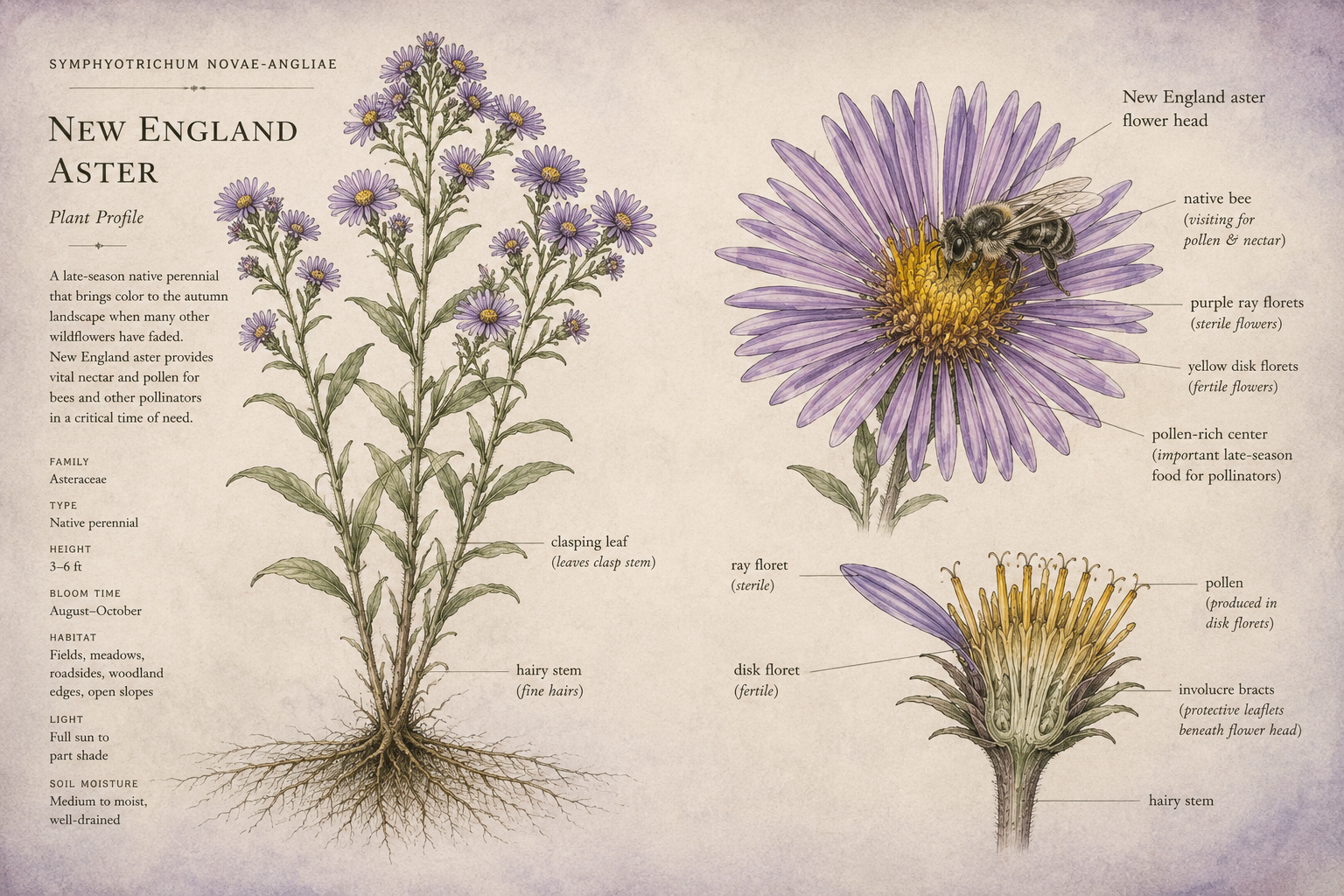
Botanical Plate

New England Aster

Botanical field-plate illustration of New England aster with flower anatomy and native bee
Symphyotrichum novae-angliae · Botanical Plate

Ecological Urgency

The Last Major Nectar Source

Timing is everything in ecology, and asters have it. While goldenrods overlap in season, asters often extend further into fall, continuing to bloom after hard frosts have silenced most other plants. For pollinators preparing for winter, this matters enormously.

Why late-season bloom matters

Monarch butterflies fuel their 3,000-mile migration to Mexico almost entirely on late-season nectar — and asters are among their most critical fueling stations. Bumblebee queens building fat reserves before overwintering, specialist bees completing their final broods, and migrating painted ladies all converge on asters in a way that is largely invisible to casual observers but ecologically irreplaceable.

This makes asters not just beautiful but ecologically urgent. A garden without late-season native flowers is a garden that fails pollinators at their most vulnerable moment. A single large aster planting in October can support hundreds of insects on a warm afternoon.

Seasonal Interest

A Year in the Life

Spring
Rosettes and young shoots emerge from the ground; foliage develops through late spring with little visual drama — asters spend spring building the infrastructure for fall
Summer
Stems elongate and branch; foliage contributes texture and habitat. Taller species may benefit from a late-June "Chelsea chop" — cutting back by half — to create bushier, better-proportioned plants
Fall
Peak bloom — the season's grand finale. Violet-blue, lavender, and purple flowers cover the plants and immediately attract migrating butterflies, late bees, and dozens of other insect species
Winter
Spent seedheads provide winter bird food and subtle structural texture; basal foliage and stems offer overwintering habitat for insects and spiders

Ohio Species

Ohio Native Asters

Ohio's native asters span a wide range of sizes, habitat preferences, and garden applications. These four are among the most ecologically valuable and garden-worthy species in the state.

Iconic · Tallgrass Prairie

New England Aster

Symphyotrichum novae-angliae

The showiest and most widely recognized native aster — large, intensely colored flowers in shades from deep violet to magenta-purple. One of the most important monarch butterfly nectar sources in the eastern United States. Bold and upright; benefits from cutting back in June to control height and improve form.

3–6 ft Full sun Medium–moist Monarch magnet

Refined · Prairie Native

Smooth Aster

Symphyotrichum laeve

An underused gem with elegant powder-blue flowers and distinctive waxy, blue-green foliage that provides interest even before bloom. More drought-tolerant than New England aster. Stays upright without staking and naturalizes beautifully. An important late-season resource for specialist native bees.

2–4 ft Full sun Dry to medium Drought tolerant

Ohio's Own · Sky-blue

Sky Blue Aster

Symphyotrichum oolentangiense

Named after the Olentangy River in Ohio — one of the few plant species directly named for an Ohio waterway. Pale sky-blue to lavender flowers on an open, airy branching structure. Well-suited to dry, lean, and sandy soils. More delicate in habit than other species, with exceptional ornamental character.

1–3 ft Full sun Dry to medium Ohio-named

Hardy · Four-season interest

Aromatic Aster

Symphyotrichum oblongifolium

One of the toughest and longest-blooming Ohio asters — distinctively fragrant foliage and a rounded, mounding habit that holds its form beautifully. Tolerates heat, drought, and poor soils. Often the last aster blooming in the garden, extending well into October and sometimes November. Excellent fall color from foliage as well as flowers.

1–3 ft Full sun Dry; heat tolerant Latest to bloom

Ecology

Wildlife Value

Asters support an exceptional range of wildlife — not just pollinators, but specialist insects, seed-eating birds, and the broader food web. Their late timing makes them irreplaceable rather than simply valuable.

Monarchs and migrating butterflies use asters as primary fueling stops, sometimes in impressive numbers on warm October afternoons. Specialist native bees — including several Andrena species that forage almost exclusively on asters — depend on the late-season pollen for completing their final broods. Goldfinches and sparrows work the seedheads through winter. Ambush bugs and predatory insects use the flowers as hunting grounds, completing their own seasonal cycles.

The dense branching structure also provides nesting sites and shelter for small insects and spiders through the dormant season. Leaving asters standing through winter is not just aesthetically rewarding — it is ecologically meaningful.

Care & Cultivation

Growing Conditions

Most Ohio native asters are adaptable and easy to grow in full sun. The key variables are moisture and height management — different species have different tolerances, and tall species like New England aster benefit from early-season pinching.

LightFull sun preferred; most tolerate part shade with reduced bloom
SoilAdaptable; most prefer average to lean soils — avoid over-fertilizing
MoistureDry to medium depending on species; New England aster prefers medium-moist
Height controlCut tall species back by half in late June ("Chelsea chop") for fuller, shorter plants
Spacing2–3 feet; clump-forming and non-invasive
DivisionDivide every 3–4 years in spring to maintain vigor
Winter careLeave standing through winter — seeds feed birds, stems harbor insects

Planting Partners

Grows Well With

Asters reach their peak when most prairie species are winding down — pair them with plants that provide earlier season interest, and asters will carry the planting through to its close.

Earlier-season partners (visual succession)

Golden Alexanders Zizia aurea
Mountain Mint Pycnanthemum spp.
Purple Coneflower Echinacea purpurea
Wild Bergamot Monarda fistulosa

Simultaneous late-season companions

Goldenrods Solidago spp.
Blazing Star Liatris spp.
Ironweed Vernonia spp.

Structural & textural companions

Switchgrass Panicum virgatum
Little Bluestem Schizachyrium scoparium
Purple Lovegrass Eragrostis spectabilis

Did You Know?

The Stories Behind This Plant

01

One Species Is Named After an Ohio River

Sky Blue Aster — Symphyotrichum oolentangiense — takes its scientific name from the Olentangy River in central Ohio, one of the few native plant species named directly for an Ohio waterway. The name was given in the 19th century when the plant was first formally described from specimens collected near the river.

The Olentangy River flows through Columbus and into the Scioto. The aster that carries its name is a characteristically Ohio prairie plant — pale sky-blue flowers, airy branching, and a tolerance for the dry, lean soils of Ohio's vanished prairie remnants. It is, in a botanical sense, a piece of Ohio's natural history encoded in a scientific name.

02

Specialist Bees Evolved Alongside Asters

Several native bee species in the genus Andrena are specialist foragers on asters — they collect pollen almost exclusively from Symphyotrichum species to feed their larvae. These bees are active in fall, timed precisely to the aster bloom, and they depend on asters being present in the landscape to complete their reproductive cycle.

Without native asters, these specialist bees cannot reproduce. Without these bees, asters are less efficiently pollinated. The relationship is an example of deep co-evolutionary interdependence — two species that have shaped each other over millions of years, and that quietly disappear together when the landscape loses its native plants.

03

"Aster" Means Star — and the Name Suits Them

The word aster comes from the Greek for star — a reference to the radiating ray petals that give asters their characteristic daisy-like form. Unlike true daisies, however, asters have a complex, multilayered flower structure: the showy "petals" are actually individual ray flowers, each one a complete flower in its own right, surrounding a central disc packed with dozens of tiny disc florets.

This means that what looks like a single aster flower is actually a composite of many individual flowers — a design shared across the entire daisy family (Asteraceae), which is one of the largest and most successful plant families on Earth. Each disc floret opens in sequence from the outside in, extending the bloom period and offering fresh nectar resources over many days.

04

They Are the Prairie's Last Act — and Its Most Important One

A prairie planting without asters is a story without an ending. All summer long, the bloom sequence moves forward — spring ephemerals, early summer umbels, midsummer coneflowers and mints, late summer grasses and goldenrods. Asters are the final chapter: the richest, most colorful, most ecologically urgent bloom of the entire year.

For the insects and birds preparing for winter or migration, that final chapter is not decorative — it is life-sustaining. The fat reserves a monarch butterfly builds on asters in Ohio in October may determine whether it survives the 3,000-mile journey to Mexico. The pollen a bumblebee queen collects from an aromatic aster in late October may be the last food she eats before overwintering. In this sense, asters are not just the end of the season. They are the reason the season matters.