Ohio Native Plant

PurpleLovegrass

Eragrostis spectabilis

The atmospheric grass — a floating cloud of rose-purple that softens prairies and moves with every breath of wind.

Blooms Late Summer · Fall
Type Warm-season grass
Height 1–2 feet
Bloom Late summer to fall
Light Full sun
Moisture Dry to medium
Soil Sandy, lean, well-drained

About This Plant

The Prairie's Atmosphere

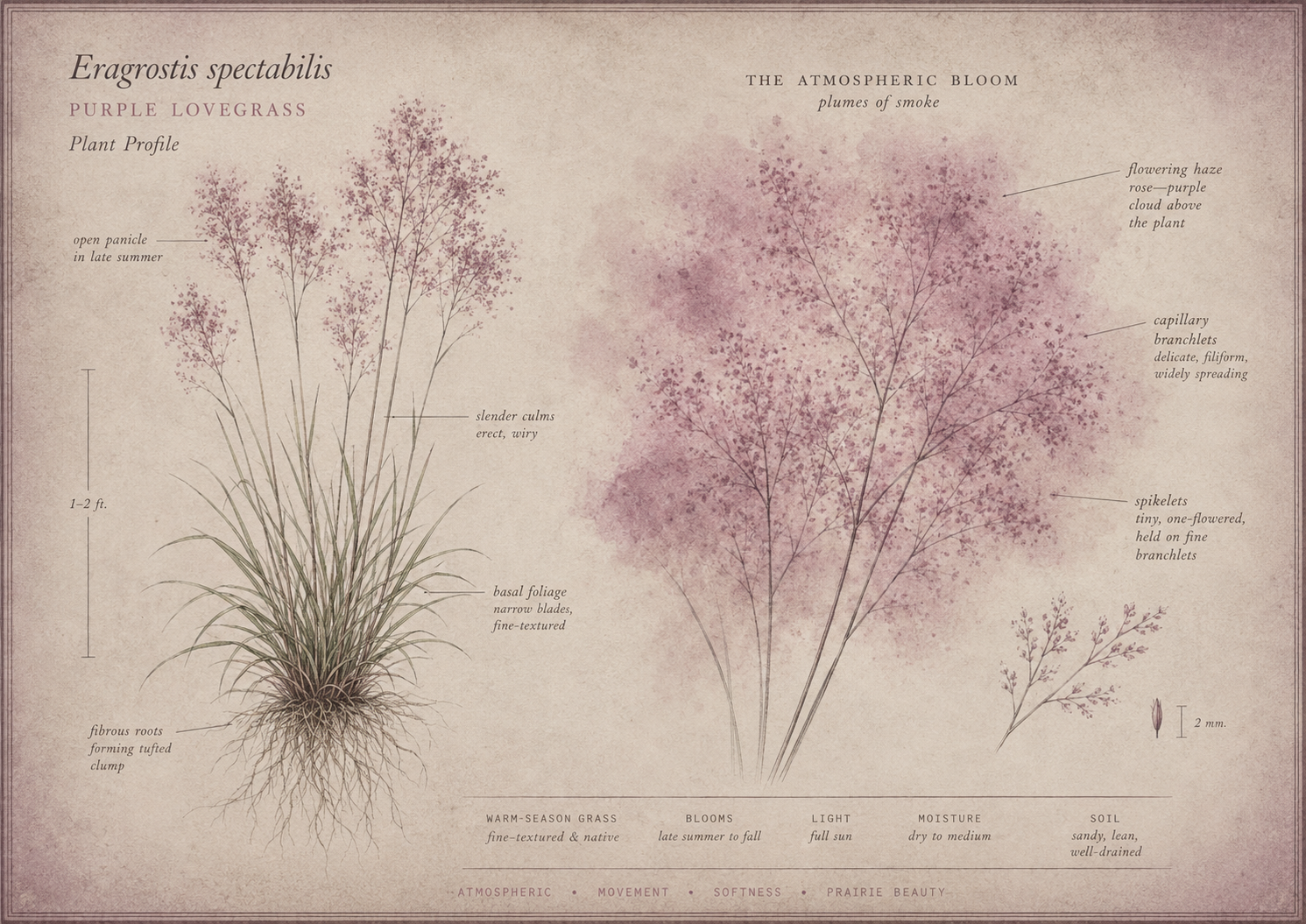
Purple lovegrass is a fine-textured native warm-season grass unlike most others — it doesn't command attention with bold structure or dramatic flowers. Instead, it creates something rarer: atmosphere. Its flowering panicles are so delicate that they form a glowing rose-purple haze above the plant, hovering like colored mist in late summer light.

In a prairie planting, this is the plant that makes everything else feel alive. It connects bolder species with softness, adds movement where there was stillness, and creates visual breathing room that keeps a meadow from feeling rigid or heavy.

"Without fine-textured matrix plants like purple lovegrass, prairie plantings can quickly feel visually heavy or static. It is the difference between a collection of plants and a composition."

Best garden uses

Prairie plantings Meadow edges Pathway softening Matrix plantings Dry meadow transitions Movement compositions

Botanical Plate

Purple Lovegrass

Botanical illustration of Purple Lovegrass
Eragrostis spectabilis · Botanical Plate

Seasonal Interest

A Year in the Life

Spring
Low mounded foliage emerges subtly, gradually thickening into fine-textured green clumps
Late Summer
Delicate flowering stems rise above the foliage — the signature floating purple-pink cloud appears, alive with movement in any breeze
Fall
The haze develops warmer bronze and tawny tones; seeds disperse on wind while the plant continues contributing softness and motion
Winter
Dormant foliage contributes fine meadow texture and subtle ground-level structure through the cold months

Ecology

Habitat Value

Purple lovegrass plays a quieter ecological role than major nectar species — but a genuinely important one. It contributes habitat complexity and microclimate structure within meadow systems that larger flowering plants cannot provide.

The dense basal foliage provides shelter for small invertebrates and ground-dwelling organisms. The fine flowering canopy creates protective microhabitat and movement throughout late summer. Small native bees and generalist insects visit the flowers, and birds may forage the seeds.

Its greatest ecological contribution, however, may be structural: as a matrix grass that weaves through and around larger species, it creates the layered, continuous habitat texture that supports a broader community of insects, spiders, and small wildlife.

Care & Cultivation

Growing Conditions

Purple lovegrass is exceptionally well-suited to lean, dry, and sandy soils where other plants may struggle. It actually performs better in lower-fertility conditions — rich soils can cause floppy growth and diminish the delicate airy habit that makes it beautiful.

LightFull sun; does not perform well in shade
SoilSandy, rocky, or lean well-drained soils; tolerates poor conditions
MoistureDry to medium; do not overwater or enrich
Height1–2 feet; low-mounded form
Spacing18–24 inches; effective in drifts and masses
BehaviorMay self-seed in ideal sandy conditions; generally well-behaved
Winter careLeave standing through winter for texture and habitat; cut back in early spring

Planting Partners

Grows Well With

Purple lovegrass is most effective when woven rhythmically through a planting — its softness creating visual breathing room between bolder structural plants.

Structural contrast companions

Rattlesnake Master Eryngium yuccifolium
Little Bluestem Schizachyrium scoparium
Switchgrass Panicum virgatum
Joe Pye Weed Eutrochium spp.

Matrix & texture companions

Prairie Dropseed Sporobolus heterolepis
Sideoats Grama Bouteloua curtipendula
Sedges Carex spp.

Pollinator sequence companions

Butterfly Weed Asclepias tuberosa
Purple Coneflower Echinacea purpurea
Blazing Star Liatris spp.
Golden Alexanders Zizia aurea

Did You Know?

The Stories Behind This Grass

01

It Doesn't Look Like Grass — It Looks Like Smoke

Most grasses look like grasses. Purple lovegrass does something else entirely. Its flower panicles are so fine, so numerous, and so loosely branched that from a few feet away they lose their individual identity entirely and merge into a floating cloud of rose-purple above the plant.

In mass plantings, this effect can be extraordinary — more like colored mist drifting through a prairie than individual plants in a garden. In late summer light, especially at dawn or dusk, the haze can appear almost luminous. It's one of the most atmospheric effects any native plant can create.

02

It Is Essentially a Living Veil

The flowering stems of purple lovegrass are so delicate that they respond to air movement that most plants ignore entirely. A breeze too light to move leaves — the kind you feel on your face but can't quite see — will set the entire flowering cloud in motion.

This makes the plant function almost like a weather instrument in the garden: when purple lovegrass moves, you know the air is alive. It adds a layer of animation and dynamism to a planting that no bold structural plant can provide. Prairie designers call this quality movement — and it's considered one of the most valuable and difficult properties to achieve in ecological landscapes.

03

The Most Important Plants Are Often the Quietest

Purple lovegrass is not a showy pollinator magnet. It doesn't have the visual drama of rattlesnake master or the ecological stardom of milkweed. In a garden survey, most people would walk past it without stopping.

But remove it from a planting, and something subtle disappears. The composition stiffens. The bolder plants look heavier. The space between them feels empty rather than alive. Matrix grasses like this are the connective tissue of a prairie — the plants that turn a collection of species into a cohesive, breathing landscape. You notice them most when they're gone.

04

It Thrives Where Others Can't

Purple lovegrass is native to dry sandy prairies, rocky outcrops, and open lean soils across the eastern and central United States. It evolved in exactly the conditions that most garden plants consider inhospitable — thin soil, low nutrients, full exposure, periodic drought.

This makes it genuinely valuable in modern landscapes, where hot dry edges, sunny strips, and lean disturbed soils are common. In those challenging spots where almost nothing else will grow gracefully, purple lovegrass not only survives — it becomes luminous. Give it poor soil and full sun, and it will give you one of the most beautiful sights in a late summer garden.