Ohio Native Plant

GoldenAlexanders

Zizia aurea

The first bright yellow of the season — and one of the most ecologically important native spring plants in Ohio.

Blooms Late Spring · Early Summer
Type Native perennial wildflower
Height 3–4 feet
Bloom Late spring to early summer
Light Full sun to part shade
Moisture Moist to medium
Soil Adaptable; tolerates clay

About This Plant

Ohio's First Spring Pollinator Plant

Golden Alexanders is one of the most important native spring wildflowers in eastern North America. Its bright yellow flower clusters emerge in late spring — earlier than most prairie plants — providing critical nectar and pollen at the exact moment many native pollinators are becoming active but have few food sources available.

In a garden, it plays two roles at once: a beautiful seasonal accent of warm gold, and a genuine ecological bridge that activates the planting weeks before summer species hit their stride.

Best garden uses

Early-season meadow plantings Pollinator gardens Prairie transitions Woodland edge Naturalistic drifts Seasonal succession planting

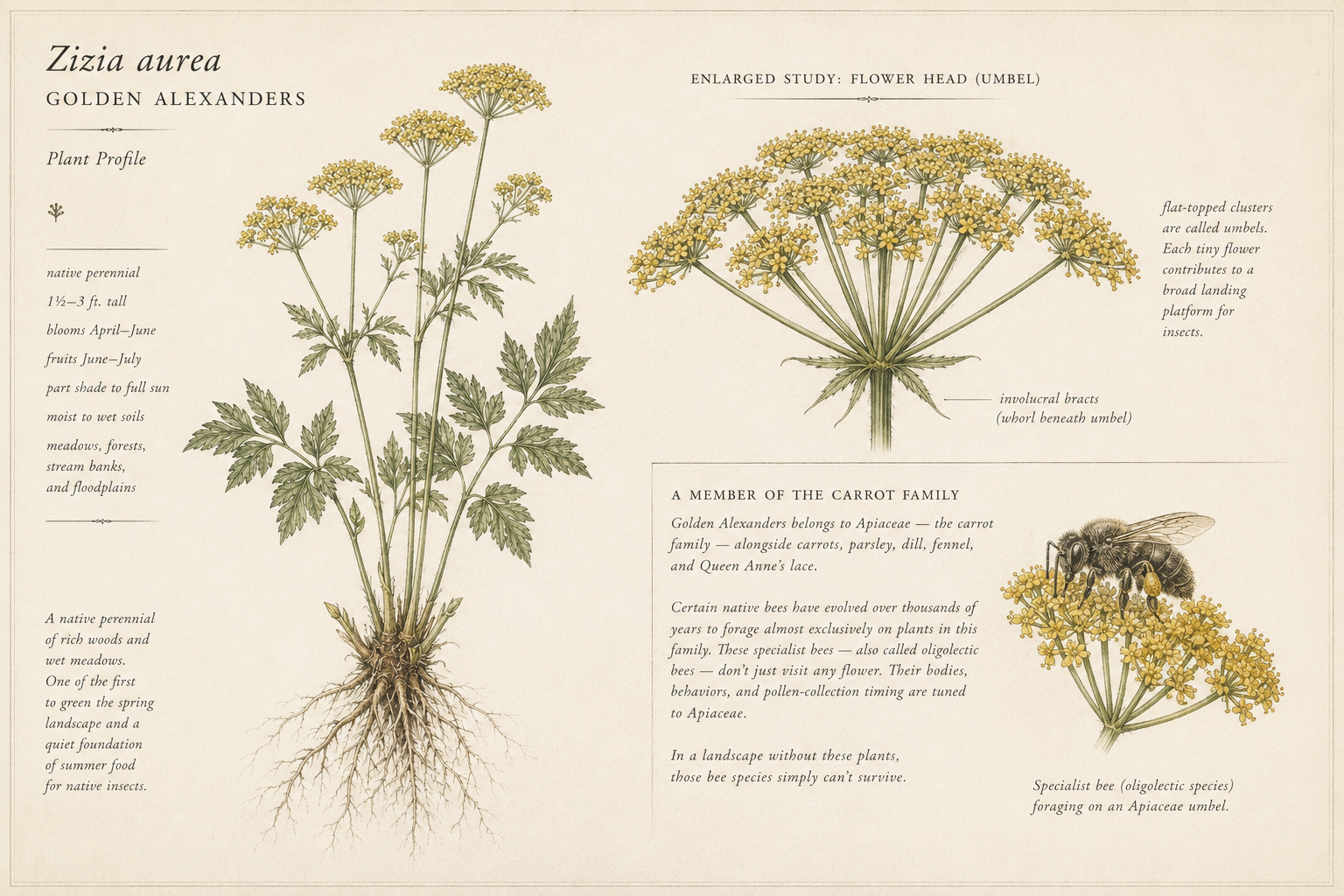
Botanical Plate

Golden Alexanders

Botanical illustration of Golden Alexanders
Zizia aurea · Botanical Plate

Seasonal Interest

A Year in the Life

Golden Alexanders earns its place in the garden across every season — not just while it's blooming.

Spring
Bright green foliage emerges early, quickly developing upright branching stems ahead of most prairie species
Late Spring
Golden-yellow umbels open and immediately attract native bees, hoverflies, wasps, beetles, and swallowtail butterflies — peak ecological activity
Early Summer
Bloom continues as later prairie species emerge around it; serves as a visual and ecological bridge into the summer planting
Summer
Seedheads and upright stems contribute light meadow texture as surrounding plants fill in
Fall
Foliage fades into the meadow matrix while contributing residual habitat structure
Winter
Dormant stems provide small-scale overwintering structure for beneficial insects

Ecology

Who Visits & Why

Golden Alexanders attracts an unusually wide variety of beneficial insects — not just the familiar bees and butterflies, but the smaller, specialist insects that are the hidden foundation of a healthy garden ecosystem.

Native bees
Sweat bees
Small carpenter bees
Hoverflies
Parasitic wasps
Predatory beetles
Black swallowtail
Specialist bees

Most pollinator gardens focus on flashy nectar flowers. But specialist bees need specific pollen relationships — without the right plants, they disappear entirely. Golden Alexanders supports deeper ecological specialization, not just general pollinator activity.

Care & Cultivation

Growing Conditions

Golden Alexanders is one of the more adaptable native plants — it tolerates part shade, performs in moist or average soils, and works in both sunny prairie plantings and woodland edges. It is generally low-maintenance once established.

LightFull sun to part shade; versatile
SoilMoist to medium; tolerates clay and average soils
MoisturePrefers consistent moisture; handles short dry spells once established
Height3–4 feet; upright and branching
Spacing18–24 inches; works well in drifts
BehaviorClump-forming; may self-seed gently in ideal conditions
Winter careLeave stems standing for overwintering insects; cut back in early spring

Planting Partners

Grows Well With

Golden Alexanders blooms earlier than most prairie plants, so pairing it with later-season species creates continuous ecological activity from spring through fall.

Structural companions

Little Bluestem Schizachyrium scoparium
Prairie Dropseed Sporobolus heterolepis
Culver's Root Veronicastrum virginicum
Joe Pye Weed Eutrochium spp.

Pollinator sequence companions

Wild Bergamot Monarda fistulosa
Butterfly Weed Asclepias tuberosa
Mountain Mint Pycnanthemum spp.
Blazing Star Liatris spp.

Texture & matrix companions

Ohio Spiderwort Tradescantia ohiensis
Foxglove Beardtongue Penstemon digitalis
Sedges Carex spp.

Did You Know?

The Stories Behind This Plant

01

It's in the Carrot Family — and That's a Very Big Deal

Golden Alexanders belongs to Apiaceae — the carrot family — alongside carrots, parsley, dill, fennel, and Queen Anne's lace. This sounds like a botanical footnote until you understand what it means ecologically.

Certain native bees have evolved over thousands of years to forage almost exclusively on plants in this family. These specialist bees — also called oligolectic bees — don't just visit any flower. Their bodies, behaviors, and pollen-collection timing are tuned to Apiaceae. In a landscape without these plants, those bee species simply can't survive.

Golden Alexanders is one of the only native Apiaceae species in most Ohio gardens. Planting it isn't just adding a flower — it's restoring a resource that specialist bees may not be able to get anywhere else nearby.

02

The Flat-Topped Flower Is an Ecological Landing Pad

Those airy, flat-topped clusters are called umbels — a structure made of dozens of tiny individual flowers packed together at the same height. The design is no accident.

Umbels offer an open, accessible landing surface with nectar and pollen exposed and easy to reach. Small insects that can't push into tubular flowers — tiny parasitic wasps, hoverflies, predatory beetles, specialist bees — can use umbels freely. A single Golden Alexanders plant in bloom is, in insect terms, a remarkably busy and democratic place: it feeds the big and the small alike.

03

Black Swallowtail Butterflies Need It to Reproduce

The black swallowtail butterfly — one of Ohio's most striking native butterflies — lays its eggs on plants in the carrot family. If you've ever found striped caterpillars on your garden parsley or dill, you've seen this relationship firsthand.

Golden Alexanders is the native ecological equivalent of those garden herbs — the plant this butterfly co-evolved with in wild systems. In a native garden, it provides a far more appropriate and ecologically honest host than imported culinary herbs. The swallowtail gets what it needs; the garden gets a butterfly that actually belongs there.

04

It Fills the Most Vulnerable Gap in the Pollinator Year

Think about the timing of a typical native garden: most prairie wildflowers bloom from midsummer onward. But native bees — especially queens establishing new colonies — need food in late spring, when almost nothing is yet in flower.

This gap is one of the most critical and commonly overlooked vulnerabilities in pollinator habitats. Golden Alexanders blooms directly into that gap. It doesn't just add spring color — it provides a life-sustaining resource at the exact moment it is scarcest. A garden with Golden Alexanders in it is a meaningfully more functional habitat than one without it.