Ohio Native Plant

PurpleConeflower

Echinacea purpurea

A bold midsummer wildflower with rose-purple drooping petals and a raised spiny cone — one of the most widely visited native plants in the summer prairie.

✦ Blooms Midsummer · Cones Persist Through Winter
Type Native perennial wildflower
Height 2–4 feet
Bloom Midsummer to early fall
Light Full sun to light part shade
Moisture Dry to medium
Soil Adaptable; tolerates clay

About This Plant

The High Summer Standard

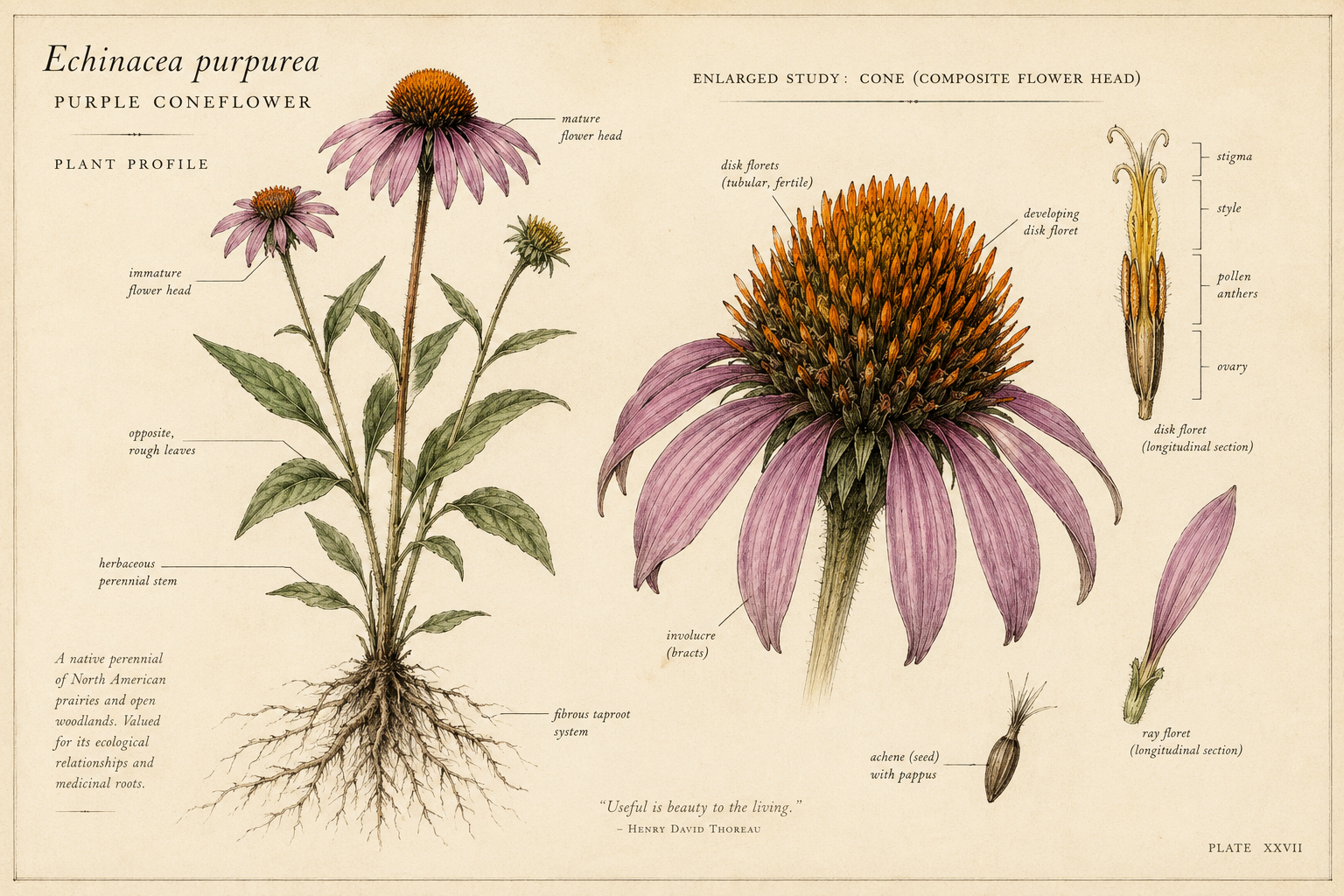
Purple coneflower blooms at the peak of summer and holds the prairie at its most generous. The flowers are large and clearly structured: rose-purple ray petals that droop gracefully away from the central cone, a raised dome of orange-brown that bristles with stiff pointed bracts, rough hairy stems, and broad dark-green leaves with a sandpapery texture. Every part of the plant is distinct and deliberate-looking.

During peak bloom from July into September, a well-established plant carries multiple flowers at different stages simultaneously — tight buds still wrapped in sepals, fully open flowers with their reflexed rays, and earlier flowers whose petals have already dropped, leaving the spiny cone standing alone on the stem. The plant is in constant motion through the season, and constantly visited by bees, butterflies, and beetles working through the flowers at every stage.

After the petals fall, the dried cone persists on the stem through fall and winter — a geometric, spiny ball that goldfinches and other small birds work steadily for seeds. The winter coneflower garden, with its upright dried stems and dark seed heads, has a sculptural quality that is as deliberately planted as any summer border.

Best garden uses

Prairie and meadow plantings Pollinator gardens Sunny borders Cut flower gardens Butterfly gardens Four-season structure

Botanical Plate

Purple Coneflower

Botanical illustration of Purple Coneflower
Echinacea purpurea · Botanical Plate

Seasonal Interest

A Year in the Life

Spring
Basal rosettes of broad, rough-textured leaves emerge; in established plants the clump gradually widens from crown offsets over time
Summer
Peak bloom from July through September — multiple flowers per plant in various stages; intensely active with bees, butterflies, beetles, and other insects throughout
Fall
Petals drop; spiny seed cones remain upright on the stems, darkening to deep brown; goldfinches and sparrows begin working the cones for seeds
Winter
Dried stems and dark cones persist through winter — structurally striking against snow, continuing to provide seeds and overwintering insect habitat

Ecology

Wildlife Value

Purple coneflower is among the most widely visited native plants during the summer months. Its large, accessible flower heads accommodate insects of many body sizes — from tiny sweat bees foraging the pollen to large bumblebees gripping the cone to swallowtail butterflies nectaring on the ray petals.

Bumblebees
Sweat bees
Eastern Tiger Swallowtail
Monarchs
Soldier beetles
Skippers
American goldfinch
Hoverflies

American goldfinches are among the most consistent visitors to coneflower seed heads in late summer and fall, clinging to the dried cones and extracting seeds with their sturdy bills. Leaving the stems standing through winter directly supports this foraging behaviour, and the dried cones remain productive well into January.

Care & Cultivation

Growing Conditions

Purple coneflower is adaptable and relatively straightforward to grow in full sun. It tolerates a wide range of soil conditions including clay, and establishes readily from transplant or direct seed. In overly rich or consistently moist conditions it may become somewhat floppy; lean to average soils produce the most upright, well-proportioned plants.

LightFull sun to light part shade; best bloom and form in full sun
SoilAdaptable — clay, loam, or lean soils all work; avoid consistently waterlogged sites
MoistureDry to medium; tolerates drought once established
Height2–4 feet depending on soil richness; lean soils produce shorter, sturdier plants
Spacing18–24 inches; clump-forming and non-invasive
DeadheadingLeave spent flowers — the cones are ecologically valuable and visually strong through winter
DivisionDivide every 3–4 years in spring to maintain vigour
Self-seedingWill self-seed in suitable conditions; seedlings are easy to transplant

Planting Partners

Grows Well With

Purple coneflower's bold upright form and warm rose-purple colouring pair well with a wide range of prairie companions. It blooms at the peak of summer and transitions naturally into the fall through its persistent seed cones.

Structural companions

Rattlesnake Master Eryngium yuccifolium
Switchgrass Panicum virgatum
Little Bluestem Schizachyrium scoparium
Culver's Root Veronicastrum virginicum

Pollinator sequence companions

Mountain Mint Pycnanthemum spp.
Wild Bergamot Monarda fistulosa
Ohio Native Asters Symphyotrichum spp.
Blazing Star Liatris spp.

Matrix companions

Prairie Dropseed Sporobolus heterolepis
Purple Lovegrass Eragrostis spectabilis
Golden Alexanders Zizia aurea

Did You Know?

The Stories Behind This Plant

01

The Drooping Petals Are Not Wilting — They Are a Signal

The characteristic reflexed ray petals of purple coneflower — drooping sharply downward from the central cone — are not a sign of stress or age. They are the plant's natural form, and they serve a functional purpose: by angling downward, the petals create a visual landing platform that guides bees toward the cone from below, while also making the flower head visible from a wider range of approach angles.

The cone itself is the functional heart of the flower — it consists of hundreds of tiny disc florets arranged in a precise spiral, opening from the outside ring inward over the course of several weeks. A single cone in full bloom may have its outermost florets producing pollen while the innermost ones are still in bud, extending the window of resource availability to visiting insects considerably beyond what a single flush of bloom would provide.

02

The Florets Open in a Spiral, from the Outside In

Look closely at a mature coneflower head and the spiral geometry becomes visible: the florets are arranged in intersecting Fibonacci spirals — the same mathematical pattern found in sunflowers, pinecones, and nautilus shells. This arrangement is not decorative; it is the most efficient way to pack the maximum number of florets into the available dome surface.

The opening sequence — outermost ring first, progressing inward over two to three weeks — means that a single flower head offers fresh pollen and nectar across an extended period. Insects returning to the same plant on successive days encounter newly opened florets at progressively inner rings. The cone is, in a functional sense, a slow-release nectar station.

03

Echinacea Comes from the Greek Word for Hedgehog

The genus name Echinacea derives from echinos — the Greek word for hedgehog or sea urchin — a reference to the spiny bracts of the central cone. The bracts are stiff and sharply pointed, and on a dried seed head they create a genuinely prickly texture that the name accurately captures.

The common name "coneflower" is equally descriptive and equally literal. Unlike many common plant names that refer to historical uses, folklore, or resemblances to other objects, both the scientific and common names of this plant simply describe what you see when you look at it — a spiny cone. It is one of the more honestly named plants in the prairie.

04

The Winter Cone Is as Ecologically Active as the Summer Flower

Most of a coneflower's ecological activity is associated with its summer bloom. But the dried seed cone that persists through fall and winter supports a different, quieter set of interactions. American goldfinches, house finches, and dark-eyed juncos forage the cones steadily from late summer onward. Small spiders and insects overwinter in the hollow stems and dried seed heads. The upright stems provide perching and foraging structure in the dormant landscape.

The instinct to cut the garden back in fall — to "tidy up" — removes all of this. A coneflower stem left standing through winter is not untidiness; it is a functioning piece of habitat. The cone that looks like it should be removed in October is still being visited by goldfinches in February. The season of ecological usefulness extends well past the season of visual beauty.