Ohio Native Plant · Perennial Wildflower

Ironweed

Vernonia spp.

Some of the most vivid purple in the Ohio late-summer landscape — a large, stiff-stemmed wildflower that blooms when much of the season has already finished.

✦ Late-Season Nectar
TypeNative perennial
Height3–8 feet
BloomAugust–October
LightFull sun to part shade
MoistureMedium to moist
HabitatMoist meadows, stream edges

About This Plant

The Purple That Holds When Everything Else Fades

Ironweed is a tall, assertive plant that reaches its peak when much of the season has already wound down. By August the first goldenrods are opening, the summer wildflowers are going to seed, and ironweed arrives — deep, saturated purple, carried high on stems that the plant has been building toward all season. The flower heads are small individually, each one a tight cluster of tubular disc florets, but they are numerous and arranged in a broad flat-topped inflorescence that can span a foot or more across.

There are no ray petals — no "petals" in the conventional sense at all. Every floret in the head is tubular, and from each one a long purple style protrudes outward, giving the whole cluster its characteristic dense, feathery texture. When the flowers finish and the seeds develop, each is topped with a bristly purple-brown pappus that catches the light differently and persists well into fall.

The ironweed–goldenrod combination — deep purple beside vivid gold — is one of the most striking colour contrasts in the late-summer Ohio landscape, and the two plants often grow together naturally in exactly the same habitats.

Best garden uses

Back of border Moist meadow Rain garden edges Stream bank plantings Monarch waystation

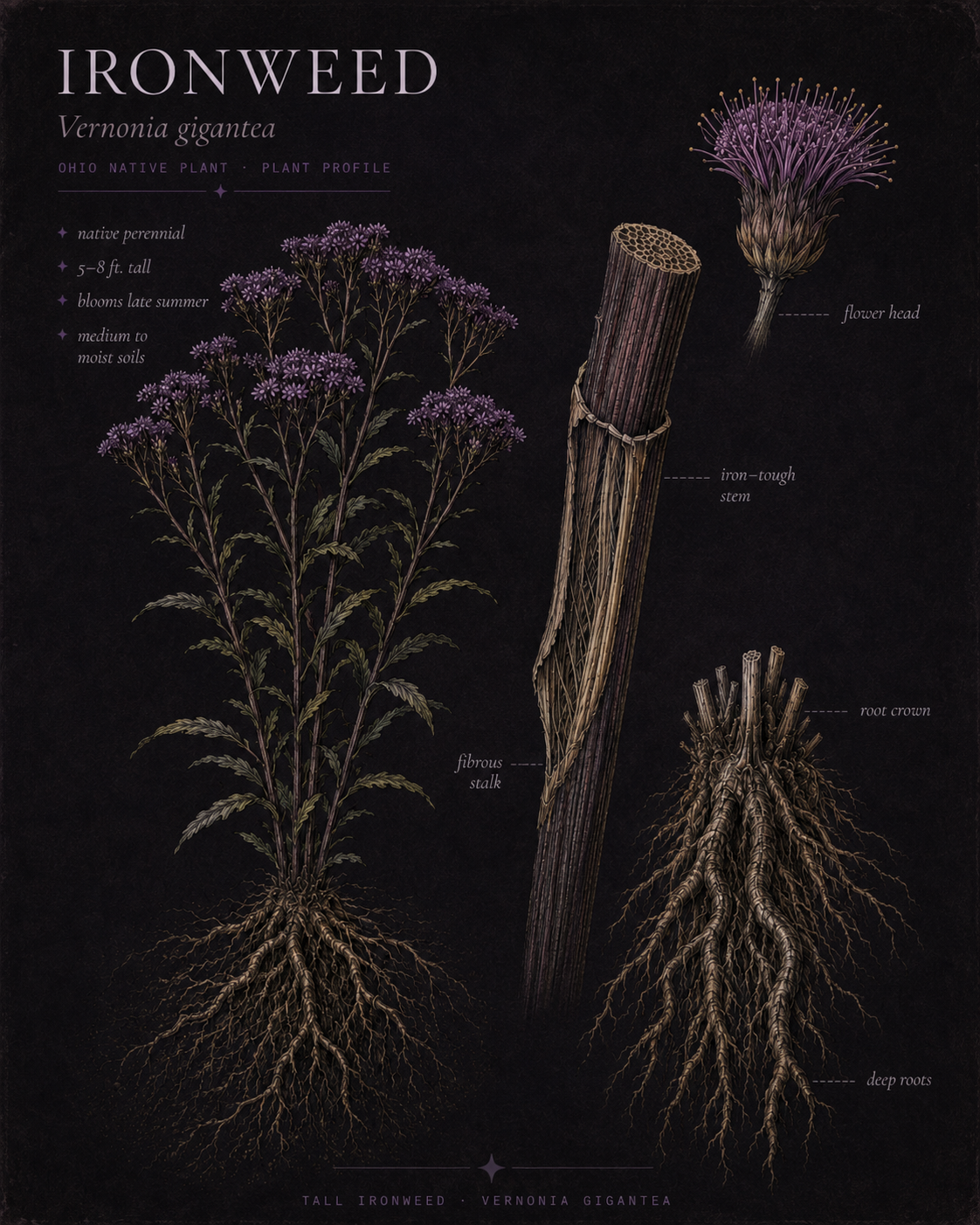
Botanical Plate

Ironweed

Botanical illustration of Ironweed
Vernonia spp. · Botanical Plate

Seasonal Interest

A Year in the Life

Spring
New shoots emerge from the crown; the plant begins building its tall framework of stems through the spring and early summer.
Summer
Stems extend to full height, often reaching five to six feet; alternate lance-shaped leaves develop all the way up; buds form at the branching tips.
Late sum.
Peak bloom through August and September — the deep purple inflorescence at full intensity, heavily visited by monarchs and bees during their late-season peak.
Fall
Florets fade; purple-brown bristly seed heads develop and catch the light; seeds disperse on the wind through October and November.
Winter
Dried stems and seed heads stand through the cold months, providing structure and seed for overwintering birds.

Wildlife Support

Who Visits

Ironweed is one of the most reliably visited late-season wildflowers in the Ohio landscape. Its bloom window coincides with the peak of monarch migration and the final intensive foraging period for many native bees before winter.

🦋Butterfliesfrequent visitors
Monarch Great Spangled Fritillary Eastern Tiger Swallowtail Spicebush Swallowtail American Lady Painted Lady Sulphurs
🐝Native Beesnectar & pollen
Bumblebees Sweat Bees Long-horned Bees Small Native Bees
🐦Birdsseed
American Goldfinch Song Sparrow Various finches

Migrating monarchs in particular visit ironweed heavily in August and September as they move south, building fat reserves for the long flight to Mexico. A planting of ironweed in late summer is reliably attended.

Care & Cultivation

Growing Conditions

Ironweed is an adaptable and vigorous plant that thrives with minimal attention. It can spread by seed in open ground, which is worth knowing before siting it in a managed border. In a naturalistic meadow or rain garden, that same quality makes it reliable and self-sustaining.

LightFull sun produces the best flowering; tolerates part shade, though plants may lean toward light and flower less prolifically
SoilAverage to moist; tolerates clay if it doesn't dry completely; adapts to most garden soils that aren't extremely dry or sandy
MoisturePrefers medium to moist; drought-tolerant once established but performs best with reliable moisture through summer
Height controlCut back by half in late June (the "Chelsea chop") for a shorter, more compact plant with delayed but abundant bloom
SpreadSelf-sows freely — deadhead if you want to limit spread; leave seed heads for birds and naturalistic effect
DivisionDivide clumps every 3–4 years in spring to control spread and renew vigour

Planting Partners

Grows Well With

The deep purple of ironweed reads most powerfully beside the warm ambers, golds, and yellows of the same late-summer season. The classic pairing is with tall goldenrod — two plants that grow together naturally and reach peak simultaneously.

The classic late-summer pairing

Tall Goldenrod Solidago altissima
Tickseed Coreopsis spp.
Blazing Star Liatris spp.

Moist meadow companions

Joe Pye Weed Eutrochium maculatum
Cardinal Flower Lobelia cardinalis
Swamp Milkweed Asclepias incarnata
Blue Vervain Verbena hastata

Structural grasses

Switchgrass Panicum virgatum
Ohio Native Asters Symphyotrichum spp.

Did You Know?

The Stories Behind This Plant

01

Named for Its Stem, Not Its Colour

The name "ironweed" has nothing to do with the vivid purple flowers. It refers to the stem — which is genuinely tough in a way that rewards testing. A dried ironweed stalk resists bending and breaking with unusual stubbornness. Farmers who mowed meadows with scythes or early mechanical equipment encountered ironweed as a plant that dulled blades and pushed back. The name is purely descriptive and entirely earned.

That same toughness extends underground. The root system is deep, extensive, and persistent, which is part of why ironweed is so difficult to eliminate once established in pasture — and why it is so reliably long-lived in a garden. The iron in the stem is a sign of how much the plant has invested below grade.

02

A Pasture Weed with an Ecological Job

Ironweed has a complicated reputation in agricultural regions. Livestock won't eat it — it contains alkaloids that make it unpalatable — so in managed pastures it spreads into gaps left by grazed species and can come to dominate. This history gave it a weedy label that stuck long past the context that earned it. In a garden, the qualities that made it troublesome in pasture are straightforward assets: it is self-sustaining, persistent, and difficult to kill. The same deep roots that resisted the scythe make it reliable through drought and cold.

03

Named for a Man Who Died Before He Could Publish

The genus Vernonia commemorates William Vernon, an English botanist who traveled to North America in the late 1690s and collected extensively along the eastern seaboard and in Maryland. He returned to England with substantial collections but died before he could publish his work. The name was applied to this genus by later botanists — a posthumous credit to someone whose contributions otherwise went unrecorded. Vernonia now comprises several hundred species distributed across tropical and subtropical regions worldwide.

04

The Purple Is Reddish for a Reason

Ironweed's purple sits distinctly on the red side of the spectrum — more magenta-violet than blue-violet — which is why it pairs so naturally with golden and amber companions rather than with cooler blues. The pigment responsible is a class of flavonoid common in Asteraceae, but the particular warmth of ironweed's hue is part of what makes it visually distinctive at a distance. In a mixed planting with goldenrod, the red-purple and the warm yellow-gold fall almost exactly opposite each other on the colour wheel.

Ohio Species

Ohio Ironweeds

Three Vernonia species grow in Ohio. They share the same vivid purple flowers and late-summer bloom; they differ mainly in height, habitat preference, and the fineness of their leaf texture.

Tallest · Wetter sites

New York Ironweed

Vernonia noveboracensis

A taller species of wet meadows and stream edges, reaching 4–8 feet in good conditions. More common in eastern and southern Ohio. The looser, slightly larger flower heads have a softer appearance than V. fasciculata.

4–8 ftMoist–wetE. & S. Ohio

Tallest of all

Tall Ironweed

Vernonia gigantea

The largest of the Ohio ironweeds, occasionally reaching 8 feet or more in rich moist soil. Found occasionally along roadsides and stream margins across the state. The flower clusters are noticeably broader and more open than the other species.

5–8 ftMoist–richOccasional

Garden context

The Classic Pairing

Vernonia + Solidago

All three Ohio ironweeds grow naturally alongside goldenrods in the same late-season moist meadows. Planting them together replicates a combination that occurs wherever both genera grow — the deep purple and warm gold are ecologically paired as well as visually.

Aug–OctPurple + gold