Ohio Native Plant · Late-Season Wildflower

Goldenrod

Solidago spp.

The defining colour of the Ohio autumn — arching golden plumes that light up moist meadows and roadsides through the closing weeks of the growing season.

✦ Ecological Keystone
TypeNative perennial
Height1–6 ft (by species)
BloomAugust–October
LightFull sun to part shade
MoistureDry to moist (by species)
HabitatMeadows, roadsides, wood edges

About This Plant

Gold at the End of the Season

Goldenrod arrives as summer tips into autumn, its arching plumes of tiny golden flowers appearing at the moment when most of the season's wildflowers are finishing. The plant has been building since spring — a steadily rising stem packed with alternate lance-shaped leaves — and the reward comes in the upper third, where the stem branches into dozens of arching racemes, each one densely covered in flower heads so small that individual blooms are nearly invisible without close inspection.

The plant is ecologically among the most productive in the eastern North American flora. Its bloom window coincides with the peak of monarch migration and the final intensive foraging push for native bees before winter. Its leaves, stems, and galls support hundreds of insect species through the growing season. And yet goldenrod is routinely kept out of gardens based on a misunderstanding that has persisted for more than a century.

Solidago is among the top five plant genera for supporting caterpillar diversity in the eastern United States — documented hosting over 100 Lepidoptera species. A goldenrod plant is not just a flower; it is a habitat structure in its own right.

Best garden uses

Back of border Naturalistic meadow Monarch waystation Rain garden edges Woodland edge (shade species) Cut & dried arrangements

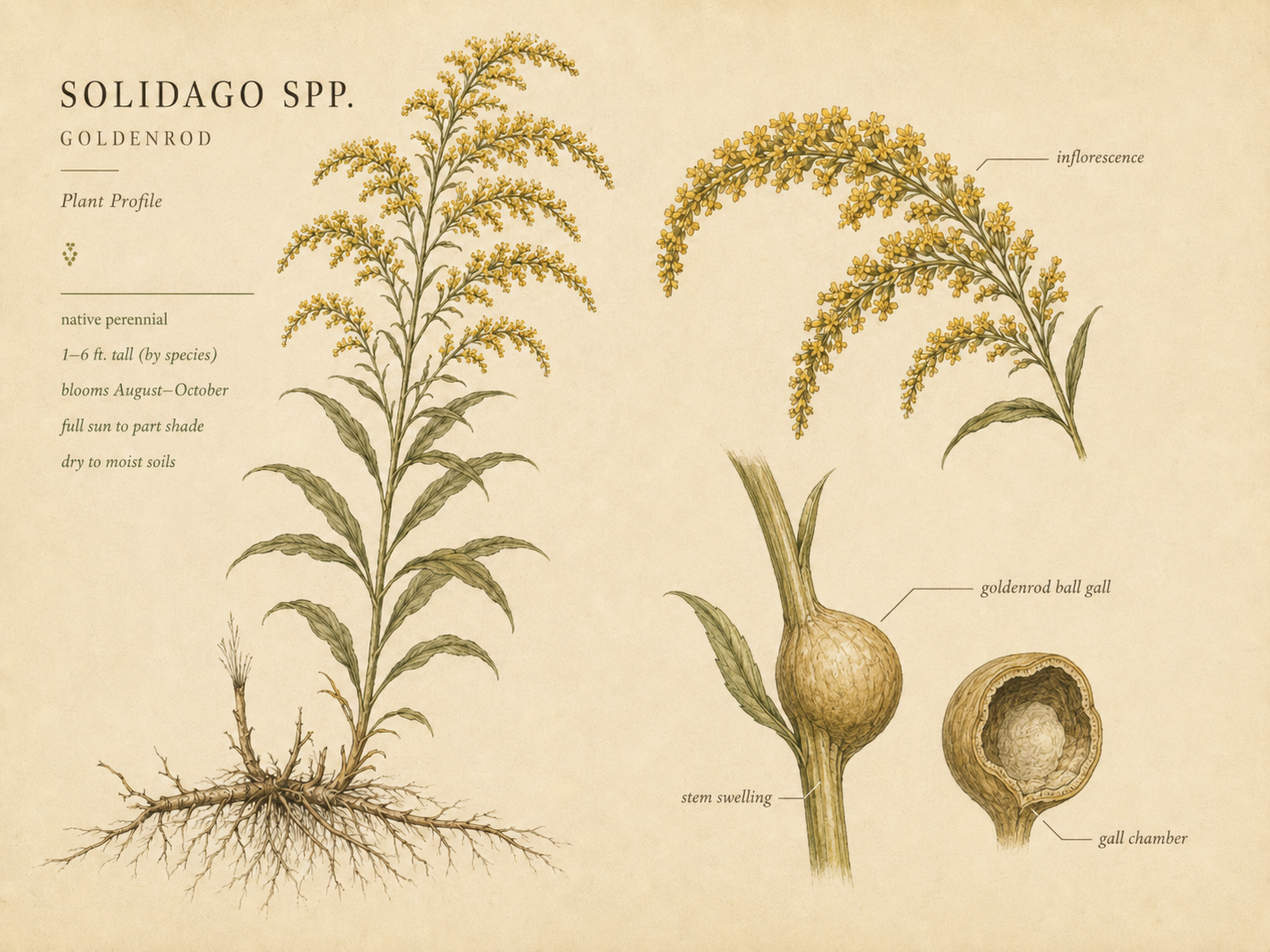
Botanical Plate

Solidago spp.

Botanical illustration of Goldenrod
Solidago spp. · Field guide botanical plate

Seasonal Interest

A Year in the Life

Spring
Basal rosettes or fresh shoots emerge early; the plant builds its full stem height through spring. A valuable caterpillar host plant from the moment the leaves appear.
Summer
Stems reach full height; gall insects, specialist bees, and beetles are active on the plant. Buds form in the upper branches through July and August.
Late sum.
Peak bloom — golden plumes at their richest through August and September. Monarchs, migrating butterflies, and a full community of native bees work the flowers through each warm day.
Fall
Flowers fade to fluffy silver seed heads; seed disperses on the wind. Stems and seed heads persist, providing structure and late-season food for birds.
Winter
Dried stems stand through winter; galls on old stems are drilled open by downy woodpeckers extracting larvae. Leave standing until spring for maximum wildlife value.

Wildlife Support

A Community, Not Just a Flower

No other Ohio native wildflower supports a broader community of insects at one time. Goldenrod is host, nectar source, pollen source, gall habitat, and shelter simultaneously — different insects using different parts of the same plant across the whole season.

🦋Butterflies & Moths100+ species
Monarch (nectar + migration fuel) Eastern Tiger Swallowtail Great Spangled Fritillary Sulphurs American Lady Many moth larvae (host)
🐝Native Beesspecialist species
Bumblebees Sweat Bees Goldenrod specialist bees (Colletes) Long-horned Bees Mining Bees (Andrena) Small Carpenter Bees
🪲Beetles & Other Insectsgall insects, predators
Goldenrod gall fly (Eurosta solidaginis) Goldenrod soldier beetle Assassin bugs (predators) Various specialist beetles
🐦Birdsseed & galls
Downy Woodpecker (excavates galls) American Goldfinch Dark-eyed Junco Various sparrows

Care & Cultivation

Growing Conditions

Most goldenrods are vigorous, adaptable plants. The common species (S. canadensis, S. altissima) can spread aggressively by rhizome in open, fertile ground — a quality to manage in a formal border, but welcome in a naturalistic meadow. Less aggressive species like S. speciosa behave well in structured plantings.

LightFull sun produces the fullest, most floriferous plants; tolerates part shade, especially the woodland species (S. caesia, S. flexicaulis)
SoilAdaptable — most species tolerate average to lean soil; rich, fertile soil encourages the aggressive rhizomatous spread of common species
MoistureDry to moist depending on species; S. nemoralis for dry sites, S. rugosa for wet edges
SpreadS. canadensis and S. altissima spread by rhizome — divide every 2–3 years or contain with edging; S. speciosa is well-behaved and clumping
Height controlCut back by one-third in late June for a shorter, more compact plant; delayed but full bloom
WinterLeave stems standing — critical for gall insects, overwintering bees in hollow stems, and birds excavating galls in winter

Planting Partners

The Classic Autumn Palette

Goldenrod's warm gold reads best beside the deep purples, russet grasses, and violet blues of the same late-season moment. The most famous pairing in American native plantings is with ironweed — two plants that share habitat and bloom window in the wild.

The classic pairing

Ironweed Vernonia spp.
Ohio Native Asters Symphyotrichum spp.
Joe Pye Weed Eutrochium maculatum

Grasses for structure & contrast

Little Bluestem Schizachyrium scoparium
Switchgrass Panicum virgatum
Prairie Dropseed Sporobolus heterolepis

Earlier season bridge

Purple Coneflower Echinacea purpurea
Blazing Star Liatris spp.

Did You Know?

The Stories Behind This Plant

01

Goldenrod Does Not Cause Hay Fever

This is one of the most consequential botanical misidentifications in American gardening history, and it has resulted in goldenrod being removed from or kept out of countless gardens where it would do enormous ecological good. The real culprit is common ragweed (Ambrosia artemisiifolia), which blooms at exactly the same time as goldenrod and produces massive quantities of lightweight, wind-dispersed pollen that travels directly into the respiratory tract.

Goldenrod's pollen is heavy, sticky, and bee-dispersed — it requires a visiting insect to transfer it from flower to flower and cannot become airborne in meaningful quantities. It is physically incapable of causing hay fever in the way that ragweed does. The confusion persists because goldenrod is highly visible along roadsides precisely when allergy season peaks, while ragweed — a dull, weedy-looking plant — goes unnoticed. The flowers that catch your eye are innocent; the ones you can't see are the problem.

02

The Gall, the Fly, and the Woodpecker

The round swellings that appear on goldenrod stems in summer are galls — chambers formed by the plant around the larvae of the goldenrod gall fly (Eurosta solidaginis). Each gall is a complete micro-habitat: a larva overwinters inside, insulated by the plant tissue, in a state of cold-induced suspended development. In winter, downy woodpeckers seek out these galls specifically, drilling into them to extract the fat-rich larva inside. A single goldenrod stem may link a fly, a plant, and a bird across three seasons — a food-web story written in a sphere of plant tissue the size of a marble.

03

Specialist Bees That Exist Only Because of Goldenrod

Several native bee species in Ohio are pollen specialists — they collect pollen almost exclusively from goldenrod. The plasterer bees (Colletes spp.) are the most notable, lining their underground nest cells with a cellophane-like secretion and provisioning them with goldenrod pollen mixed with nectar. Their flight season is timed precisely to goldenrod bloom, and they may reproduce only once a year. A yard without goldenrod cannot support these bees. A yard with it provides the single resource they cannot substitute.

04

Ohio Has Its Own Species — and It's Rare

Solidago ohioensis — Ohio goldenrod — is named for this state and is found almost nowhere else. It is a fen specialist, restricted to the calcareous peat fens of northern Ohio and a handful of scattered sites in adjacent states. It grows in conditions that very few plants tolerate — wet, highly alkaline, nutrient-poor peat — and the loss of Ohio's fen habitats to drainage and development has made it rare. It is not a garden plant, but it is a reminder that the genus Solidago contains both the common and the imperiled, often within the same county.

Ohio Species

Ohio Goldenrods

Ohio has more than a dozen native Solidago species, ranging from aggressively colonising meadow plants to politely clumping woodland understory species. Four are particularly useful in garden settings.

Garden-friendly · Upright

Showy Goldenrod

Solidago speciosa

The goldenrod for the formal border — upright, clumping, not rhizomatous, with stiff erect flower spikes rather than arching plumes. One of the most ornamental species, well-behaved and showy. Dry to medium soils, full sun.

2–4 ftDry–mediumClumpingUpright

Shade tolerant · Moist

Wrinkleleaf Goldenrod

Solidago rugosa

A goldenrod for moist to wet soils and partly shaded sites — it tolerates conditions that most Solidago cannot. Large, strongly-veined (wrinkled) leaves and arching yellow plumes. Good for moist rain garden edges or wet woodland openings.

2–4 ftMoist–wetPart shade

Deep woodland

Bluestem Goldenrod

Solidago caesia

A shade-woodland species with distinctive blue-green stems and small yellow flowers clustered in the leaf axils rather than in terminal plumes — a completely different architectural form. One of the very few goldenrods for dry to medium shade.

1–3 ftDry–mediumShadeAxillary flowers