Ohio Native Plant · Summer Perennial

FalseSunflower

Heliopsis helianthoides

Golden daisy-like flowers from June well into fall, on a sturdy prairie plant whose ray florets — unlike a true sunflower's — each set seed and stay attached as the head ripens.

✦ Blooms June – September
TypeNative perennial
Height3–5 feet
BloomJune–September
LightFull sun to part shade
MoistureDry to medium
FamilyAsteraceae

About This Plant

A Sunflower That Isn't One

False sunflower is a stout, upright perennial of open ground — prairies, meadow edges, roadsides, streambanks, and woodland borders across Ohio. It forms a branching clump 3 to 5 feet tall, with opposite, coarsely toothed leaves and golden daisy-like heads held on stiff stems. Each head carries eight to sixteen broad ray florets, often slightly notched at the tip, around a raised dome of yellow-brown disk florets. The bloom begins in June and, on a well-sited plant, continues in waves into September.

At a glance it reads as a sunflower, which is exactly what its name records: Heliopsis means "resembling the sun," and the species name helianthoides means "like Helianthus" — the true sunflowers. The plant is named twice over for a resemblance it doesn't quite belong to. The differences are real and worth knowing, and they begin with the rays.

The flowering window runs for roughly three to four months — among the longest of any Ohio native perennial. A single clump can supply nectar and pollen continuously from the early-summer gap through the late-season rush, spanning the active periods of successive bee generations rather than a single brief pulse.

Best garden uses

Pollinator gardens Prairie & meadow plantings Sunny borders Naturalised areas Back-of-border structure Cut flower gardens

Botanical Plate

False Sunflower

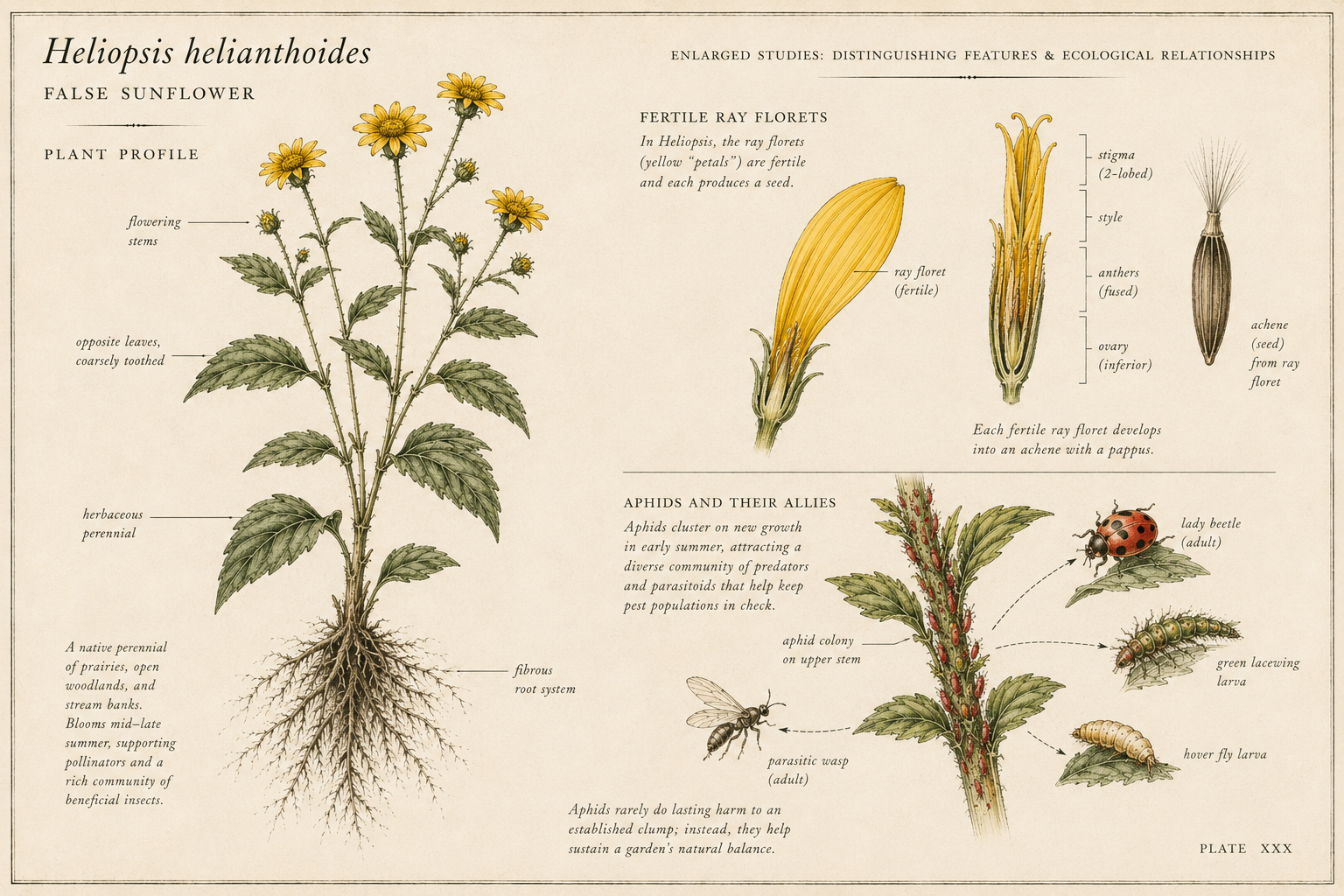
Botanical field-plate illustration of False Sunflower
Heliopsis helianthoides · Botanical field plate

Seasonal Interest

A Year in the Life

Spring
A clump of opposite, sharply toothed leaves emerges and bulks up quickly; branching stems extend through late spring as buds form at the tips.
Early sum.
First heads open in June, in the lull after spring wildflowers and before the midsummer prairie peaks — worked steadily by bees, beetles, and flies.
Summer
Peak bloom; new heads continue opening across the plant for weeks. Removing spent heads prompts further branching and extends the display.
Late sum.
Flowering carries on as the earliest heads ripen; the persistent rays dry in place while seed sets in both ray and disk florets.
Fall–Win.
Seed heads stand into autumn and winter, drawing goldfinches and other seed-eaters; left uncut, the stems provide structure and overwintering cover.

Wildlife Support

Who Visits

The open, shallow heads of false sunflower present nectar and pollen on an accessible flat face, so the visitor list is broad rather than specialised — short- and long-tongued bees, beetles, flies, and butterflies all work the same flower. The fertile ray florets mean pollen and seed are produced across the whole rim of the head, not only at its centre.

🐝Beesprimary visitors
Bumblebees Sweat Bees Leafcutter Bees Mining Bees Long-horned Bees
🪲Beetles & Predatorsfood web
Soldier Beetles Lady Beetles Green Lacewings Hover Flies
🦋Butterflies & Mothsnectar
Skippers Painted Lady Wavy-lined Emerald Moth
🐦Birdsseed
American Goldfinch Black-capped Chickadee Song Sparrow

False sunflower is also known for carrying aphid colonies, particularly on the upper stems in early summer. Rather than a problem to be managed away, these aphids often function as an early-season food source for lady beetles, lacewing larvae, hover-fly larvae, and parasitic wasps — predators that then remain in the garden to work nearby plants.

Care & Cultivation

Growing Conditions

False sunflower is among the easier native perennials to establish, asking little once its roots are down. The main thing to manage is its vigour: in rich soil and part shade it grows tall and may lean, while leaner soil and full sun produce a shorter, sturdier, more self-supporting plant.

LightFull sun to part shade; fullest, sturdiest bloom in sun; tolerates light shade with a looser habit
SoilAdaptable — average to lean, loam to clay; rich soil encourages tall, floppy growth
MoistureDry to medium; drought-tolerant once established; tolerates occasional moisture
Height3–5 feet; staking rarely needed in lean soil and full sun
DeadheadingOptional; removing spent heads prompts rebloom and limits self-sowing — leaving them feeds birds
Self-sowingSeeds readily in open ground; volunteer seedlings are easy to move or remove
DivisionDivide clumps in spring or fall every few years to keep them vigorous
Cutting backLeave stems standing through winter for seed and cover; cut back in early spring

Planting Partners

Grows Well With

False sunflower's long bloom and upright habit make it a dependable mid-to-back-of-border presence that overlaps almost every other summer and fall native. It pairs naturally with the grasses that keep it standing and with the bloom sequence on either side of its own.

Structure & matrix grasses

Little Bluestem Schizachyrium scoparium
Prairie Dropseed Sporobolus heterolepis
Switchgrass Panicum virgatum

Summer bloom partners

Purple Coneflower Echinacea purpurea
Wild Bergamot Monarda fistulosa
Butterfly Weed Asclepias tuberosa
Tickseed Coreopsis spp.

Late-season handoff

Goldenrod Solidago spp.
Ironweed Vernonia spp.
Ohio Native Asters Symphyotrichum spp.

Did You Know?

The Stories Behind This Plant

01

Every Petal Sets a Seed

In a true sunflower (Helianthus), the showy outer "petals" are ray florets that are sterile — they advertise the flower but set no seed, and all the seed forms in the central disk. False sunflower works differently: its ray florets are fertile. Each ray produces a seed, so the outer rim of every head sets seed alongside the disk. This is one of the clearest technical features separating Heliopsis from Helianthus, even though the two look much alike.

A second tell follows from it: the rays of false sunflower tend to persist rather than drop. As the head matures they stay attached, fading to a papery cream rather than falling away, so a ripening false sunflower keeps its star shape long after a true sunflower would have shed its petals. If the rays are still there as the seeds fill, you are almost certainly looking at Heliopsis.

02

It Fills the Early-Summer Gap

There is a quiet stretch in the native garden after the spring wildflowers finish and before the prairie reaches full midsummer bloom. False sunflower opens into that gap in June and keeps going, often into September. For pollinators, this matters less as a single moment than as duration — a continuous supply across months that overlaps the foraging of one bee generation after another, when many showier plants offer only a brief window.

03

The Aphids Are Doing a Job

False sunflower has a reputation for attracting aphids, which cluster on the upper stems in early summer. Left alone, those colonies tend to draw in the insects that eat them — lady beetles, the alligator-like larvae of green lacewings, hover-fly larvae, and tiny parasitic wasps. A plant covered in aphids in June is often a plant quietly feeding the next month's predators, which then move on to patrol the rest of the garden. The aphids rarely do lasting harm to an established clump.

04

A Caterpillar That Wears the Flower

The wavy-lined emerald moth (Synchlora aerata) lays eggs on the flower heads of many native composites, false sunflower among them. Its caterpillar does something unusual: it snips small pieces of the flower — bits of disk and ray — and attaches them to its own back, rebuilding the disguise as the pieces wither. A caterpillar feeding on a false sunflower can be almost impossible to spot, because it is wearing the flower it is eating.

Telling Them Apart

Yellow Composites of the Ohio Prairie

Several tall, yellow, daisy-like natives share a habitat and a general look. The differences come down to the central disk, the rays, and the leaves — once you know where to look, they sort out quickly.

True sunflowers

Sunflowers

Helianthus spp.

Rays are sterile and drop as seed fills the disk; leaves often alternate higher on the stem. Many Ohio species, mostly blooming later, late summer into fall.

Sterile raysDisk seedBlooms later

Dark-centred

Black-eyed Susan

Rudbeckia hirta

Yellow-orange rays around a dark brown, dome-to-cone central disk; bristly-hairy stems and leaves. Shorter than false sunflower, with an unmistakable dark eye.

1–3 ftDark diskHairy

Tall & coarse

Cup & Compass Plants

Silphium spp.

Very tall, coarse-leaved prairie plants with yellow heads; identified by features like fused cup-forming leaves or large, deeply cut basal leaves. Far larger in scale than false sunflower.

5–8 ftCoarse leavesPrairie