Ohio Native Plant · Summer Wildflower

Black-eyedSusan

Rudbeckia hirta

Golden rays around a dark, domed eye — a fast, sun-loving pioneer that blooms from June into October and reseeds itself freely across open ground.

✦ Blooms June – October
TypeShort-lived perennial / biennial
Height1–3 feet
BloomJune–October
LightFull sun
MoistureDry to medium
FamilyAsteraceae

About This Plant

Quick to Arrive, Generous While It Stays

Black-eyed Susan is among the first native wildflowers most gardeners meet — a bristly, upright plant carrying golden daisy-like heads, each a ring of yellow ray florets around a raised, dark brown-purple central cone. The whole plant is rough to the touch: the species name hirta means "hairy," and the stems and leaves are covered in short stiff bristles. It blooms over a long stretch, June into October, on dry to average ground in full sun.

It is less a fixture than a traveller. Most plants behave as biennials or short-lived perennials, flowering hard for a season or two and then giving way — but they reseed readily into open soil, so a colony tends to move around a planting over the years rather than hold one spot. This habit is the key to understanding both how it grows and where it fits.

Black-eyed Susan is a pioneer: fast to germinate, quick to bloom, and well-suited to bare or disturbed ground. In a new prairie planting it often flowers heavily in the first year or two while slower, longer-lived perennials are still building roots — providing early cover, nectar, and structure, then thinning as the planting matures around it.

Best garden uses

New prairie plantings Pollinator gardens Sunny borders Meadow gaps & edges Disturbed / bare ground Cut flower gardens

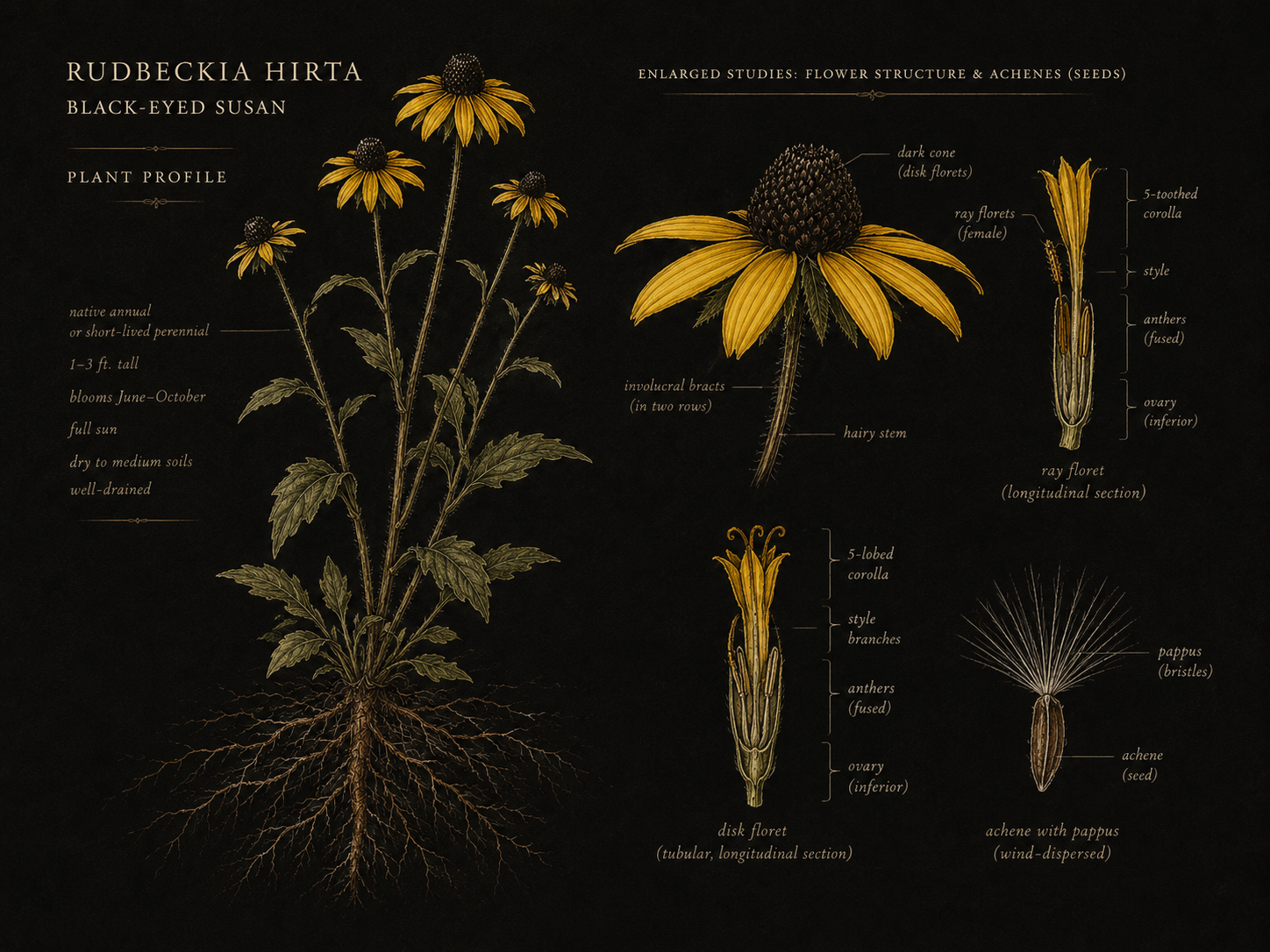
Botanical Plate

Black-eyed Susan

Botanical field-plate illustration of Black-eyed Susan
Rudbeckia hirta · Botanical field plate

Seasonal Interest

A Year in the Life

Spring
Bristly basal rosettes establish or last year's seedlings green up; flowering stems begin to rise in late spring. Self-sown seedlings are easy to spot and move while small.
Summer
First heads open in June and continue in succession through the summer — the long, steady peak, worked by a wide range of bees and butterflies.
Late sum.
Bloom carries on; the earliest heads ripen as the dark cones fill with seed. Deadheading prolongs flowering, while leaving heads sets seed for next year.
Fall–Win.
Dark seed cones stand on stiff stems, drawing goldfinches and other small birds; the dried structure holds well into winter if left uncut.

Wildlife Support

Who Visits

The open, flat-faced heads present nectar and pollen on an easy landing surface, so the visitor list is broad rather than specialised. The reward is concentrated in the dark central disc, where dozens of tiny florets open in sequence from the outer ring inward over many days.

🐝Beesprimary visitors
Sweat Bees Bumblebees Mining Bees Leafcutter Bees Small Carpenter Bees
🦋Butterflies & Mothsnectar & host
Silvery Checkerspot Skippers Painted Lady Wavy-lined Emerald Moth
🐦Birdsseed
American Goldfinch Black-capped Chickadee Song Sparrow

The silvery checkerspot butterfly uses Black-eyed Susan and related composites as a larval host plant — females lay eggs on the foliage, and the caterpillars feed on the leaves. A planting that tolerates some leaf chewing is doing exactly what a host plant is meant to do.

Care & Cultivation

Growing Conditions

Black-eyed Susan is easy to establish and asks for little. The main thing to understand is its life cycle: because individual plants are often short-lived, a long-term presence depends on letting at least some seed set and fall, or on occasional reseeding.

LightFull sun; tolerates very light shade with a looser, leggier habit
SoilAdaptable — average to lean, well-drained; tolerates poor and disturbed soils
MoistureDry to medium; drought-tolerant once established; dislikes consistently wet ground
LifespanOften biennial or short-lived; persists in the garden by reseeding rather than longevity
DeadheadingExtends bloom; leave some heads late in the season to set seed for next year
Self-sowingReseeds freely into open soil; seedlings transplant easily when small
Winter careLeave seed cones standing for birds and structure; cut back in early spring

Planting Partners

Grows Well With

As an early, fast-blooming pioneer, Black-eyed Susan pairs naturally with the slower perennials it shares a season with — and with the grasses that give a planting its standing structure once the susans begin to move on.

Summer prairie partners

Purple Coneflower Echinacea purpurea
Wild Bergamot Monarda fistulosa
Tickseed Coreopsis spp.
Blazing Star Liatris spp.

Grasses & structure

Little Bluestem Schizachyrium scoparium
Prairie Dropseed Sporobolus heterolepis
Switchgrass Panicum virgatum

Into the late season

Goldenrod Solidago spp.
Ohio Native Asters Symphyotrichum spp.
Ironweed Vernonia spp.

Did You Know?

The Stories Behind This Plant

01

Named for Two Botanists and a Head of Hair

The genus Rudbeckia was named by Carl Linnaeus in honour of Olof Rudbeck the Elder and his son Olof Rudbeck the Younger — Swedish botanists at Uppsala University, where the younger Rudbeck had been Linnaeus's teacher and patron. Naming a genus after a mentor was, in the eighteenth century, a considerable tribute, and Linnaeus chose a plant he admired for it.

The species name hirta is more literal: it is Latin for "hairy" or "rough," describing the short stiff bristles that cover the stems and leaves. Run a finger along the stem and you can feel exactly why it earned the name — the texture is one of the quickest ways to tell Rudbeckia hirta from its smoother relatives.

02

A Plant That Doesn't Stay Put

Many gardeners are surprised when their Black-eyed Susans seem to "wander" — flowering in one spot one year and a few feet away the next. This is not decline but design. As a short-lived plant that reproduces mainly by seed, it colonises open gaps, blooms, sets seed, and lets the next generation establish wherever there is bare soil. In a maturing planting it gradually yields ground to longer-lived perennials, persisting at the edges and in any disturbance. Understanding it as a moving rather than a fixed plant is the key to keeping it around.

03

Bees See a Target We Can't

To human eyes, a Black-eyed Susan is a uniform ring of yellow around a dark centre. To a bee, it is something else entirely. The ray florets reflect ultraviolet light unevenly: their outer halves throw back UV while their bases absorb it, creating a dark ultraviolet "bullseye" around the central disc that is invisible to us but vivid to a pollinator's UV-sensitive vision. The pattern functions as a nectar guide, steering visiting insects straight to the florets at the centre — a piece of signage written in a colour we cannot see.

04

The Dark Cone Feeds Two Seasons

The "black eye" is not one structure but a packed dome of many tiny disc florets, each a complete flower. Through summer those florets supply nectar and pollen to bees and butterflies. After bloom, the same cone dries and fills with small seeds, and in fall and winter it becomes a perch and a larder for goldfinches and other small birds that work the heads for seed. Leaving the spent cones standing extends the plant's usefulness well past its flowering — one structure doing two seasons of work.

Ohio Species

Ohio Rudbeckias

Several native Rudbeckia grow in Ohio, sharing the dark-centred, golden-rayed flower but differing in height, habit, lifespan, and habitat. Knowing them apart helps in choosing the right one — and in recognising that "Black-eyed Susan" properly refers to just one of them.

Reliably perennial

Orange Coneflower

Rudbeckia fulgida

A longer-lived, clump-forming perennial that returns dependably year to year. Smaller flowers than hirta but many of them, blooming late summer into fall. The widely sold cultivar 'Goldsturm' comes from this species; the straight native species is the better ecological choice.

2–3 ftPerennialLate summer

Bushy & floriferous

Brown-eyed Susan

Rudbeckia triloba

A tall, much-branched, short-lived plant that carries a profusion of small dark-centred flowers — among the most generous bloomers in the genus. Excellent for pollinators; like hirta, it persists by reseeding rather than longevity.

2–5 ftMany small headsReseeds

Tall & moisture-loving

Cutleaf Coneflower

Rudbeckia laciniata

A very tall species of moist ground, stream edges, and floodplains — reaching well over head height. Drooping yellow rays around a green-yellow (not dark) central cone distinguish it at a glance. A bold back-of-border or wet-edge plant.

5–9 ftMoist–wetGreen cone