Ohio Native Tree · Small Tree / Shrub

Serviceberry

Amelanchier laevis

Among the first trees to bloom in spring — white blossom before the woods leaf out, edible berries in June, fiery fall color, and smooth silver-grey bark in winter.

✦ Four-Season Interest
TypeSmall tree / large shrub
Height15–25 ft (to 40)
BloomEarly spring (April)
LightFull sun to part shade
MoistureMedium; well-drained
FruitJune; edible

About This Plant

First to Bloom at the Woodland Edge

Serviceberry is a small tree or large multi-stemmed shrub of woodland edges, open woods, and stream banks across Ohio. In early spring — often in April, before the surrounding canopy has leafed out — it opens drooping clusters of white flowers, each with five narrow, slightly twisted petals that give the whole tree an airy, almost smoky appearance from a distance. As the flowers fade, young leaves emerge with a bronze or coppery tint before settling to soft blue-green.

It earns its place in a garden several times over across the year: the early flowers, edible reddish-purple fruit in June, orange-to-red foliage in fall, and smooth silver-grey bark — often subtly striped — that carries the bare winter form. Few native trees of its modest size offer something in every season the way serviceberry does.

Serviceberry is among the earliest native trees to flower, opening before most woody plants have broken bud. That early timing puts pollen and nectar within reach of the first native bees of the year — mining bees and mason bees active in a season when few other trees offer anything at all.

Best garden uses

Woodland edge Small specimen tree Naturalistic borders Wildlife & bird gardens Understory layer Edible landscaping

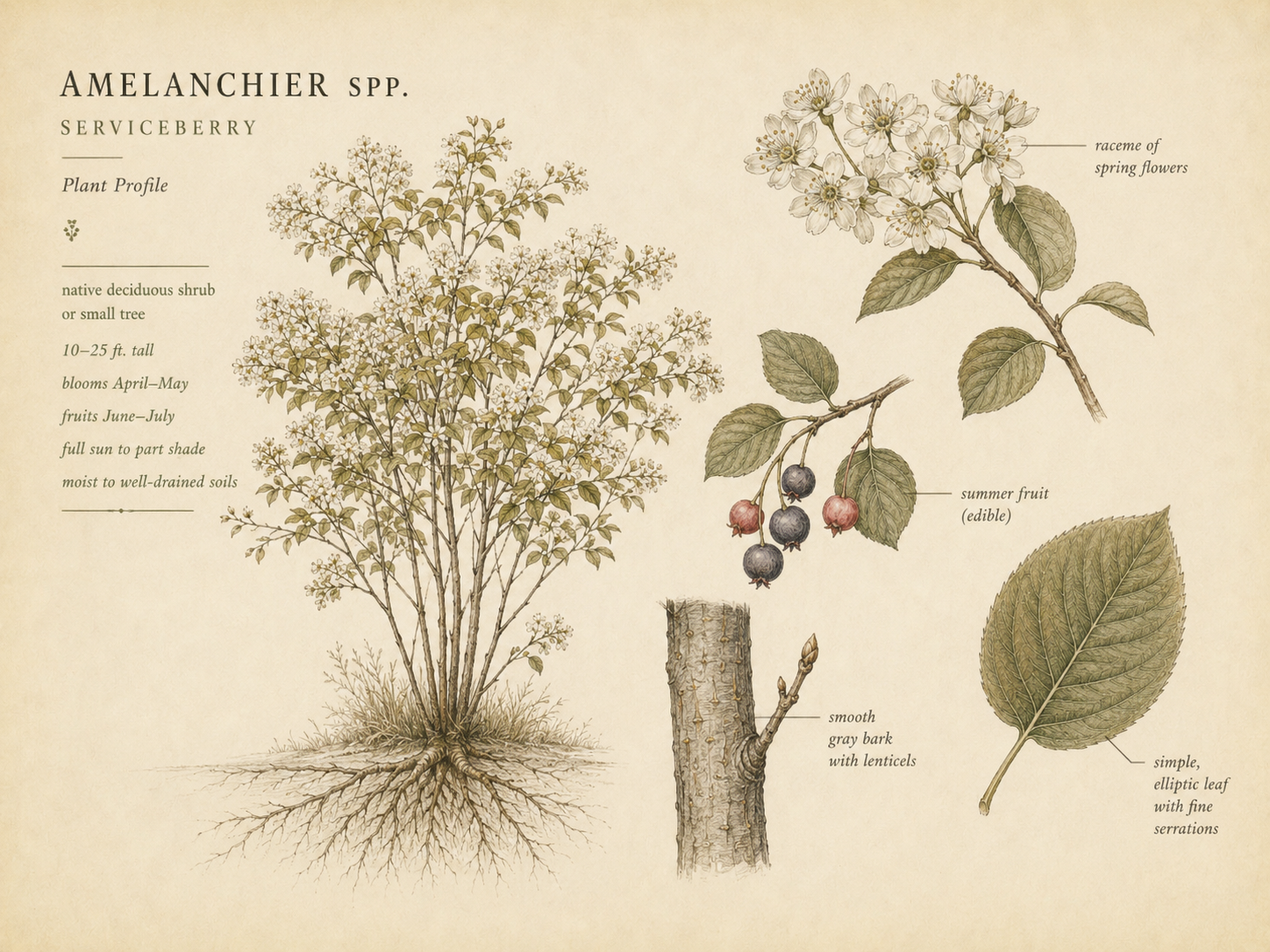
Botanical Plate

Serviceberry

Botanical field-plate illustration of Allegheny Serviceberry
Amelanchier laevis · Botanical field plate

Seasonal Interest

A Year in the Life

Spring
Among the first trees to flower — drooping racemes of white blossom open in April, often before the woods leaf out, as bronze-tinged young leaves emerge. Early bees work the flowers.
Early sum.
Fruit develops and ripens in June, passing from green through red to deep purple. Birds — and people — compete for the sweet, edible berries as foliage settles to blue-green.
Fall
Foliage turns warm orange to red, among the more reliable small trees for fall color in part shade. A quiet but vivid close to the season.
Winter
Smooth silver-grey bark, often with darker vertical striping, and a fine multi-stemmed branching structure carry the bare-branch form through the cold months.

Wildlife Support

Who It Feeds

Serviceberry supports wildlife at both ends of the growing season and underneath it — early flowers for emerging bees, June fruit for birds, and foliage that feeds a wide range of caterpillars through the summer.

🐝Early-Spring Beesnectar & pollen
Mining Bees (Andrena) Mason Bees Bumblebee Queens Small Carpenter Bees
🦋Butterflies & Mothshost plant
Red-spotted Purple Viceroy Eastern Tiger Swallowtail Striped Hairstreak
🐦Fruit-Eating BirdsJune berries
Cedar Waxwing American Robin Gray Catbird Wood Thrush Northern Cardinal

Serviceberry is a larval host plant for a wide range of butterflies and moths, whose caterpillars feed on the foliage — and those caterpillars are, in turn, the protein that most songbirds rely on to raise their young. A serviceberry feeds birds twice over: caterpillars in spring and early summer, fruit in June.

Care & Cultivation

Growing Conditions

Serviceberry is adaptable and undemanding, tolerating a range of light from full sun to part shade — though flowering, fruiting, and fall color are all fullest with more sun. It is well-suited to the woodland-edge conditions of its native range.

LightFull sun to part shade; flowers, fruit, and fall color fullest in sun; tolerates dappled woodland light
SoilAdaptable; prefers moist, well-drained, slightly acidic soil with organic matter; tolerates a range of textures
MoistureMedium; consistent moisture suits it best; avoid prolonged drought when young
FormAvailable as single-stemmed small tree or multi-stemmed shrub; choose to suit the spot
FruitEdible reddish-purple pomes ripen in June; birds usually harvest quickly unless netted
Fall colorOrange to red; more vivid with more sun
NoteAs a member of the rose family, it can host cedar-serviceberry rust near junipers — usually cosmetic, rarely harmful

Planting Partners

Grows Well With

Serviceberry sits naturally at the woodland edge, where it pairs with other small trees and shrubs of that transitional zone and lifts above a ground layer of shade-tolerant wildflowers and sedges.

Woodland-edge trees & shrubs

Witch Hazel Hamamelis virginiana
Red Buckeye Aesculus pavia
White Oak Quercus alba

Understory & ground layer

Pennsylvania Sedge Carex pensylvanica
Foxglove Beardtongue Penstemon digitalis
Nodding Onion Allium cernuum
Wild Ginger Asarum canadense

Early-season companions

Golden Alexanders Zizia aurea
Woodland Phlox Phlox divaricata
Wild Geranium Geranium maculatum

Did You Know?

The Stories Behind This Plant

01

A Tree With Half a Dozen Names

Few native plants carry as many common names as this one: serviceberry, juneberry, shadbush, shadblow, sugarplum, and — in Canada, where the fruit is grown commercially — saskatoon. Each name records a different way people noticed the tree. Juneberry marks when the fruit ripens. Shadbush recalls that it blooms just as shad run up the rivers to spawn, an old coastal calendar written in flowers.

The name serviceberry itself is debated. One common explanation holds that its early bloom coincided with the spring thaw, when mountain ground softened enough for burials and traveling preachers could resume holding services — so the tree flowered at "service" time. Whether or not the folk story is literally true, it captures something real: serviceberry blooms at the hinge of the year, when winter loosens its grip.

02

The Fruit Isn't Really a Berry

Despite the names, a serviceberry "berry" is botanically a pome — the same fruit type as an apple or pear, to which it is closely related within the rose family (Rosaceae). The small reddish-purple fruits are genuinely good to eat: sweet, faintly almond-flavored from the seeds, and often compared to blueberries. The catch is timing — birds tend to strip a tree within days of ripening, so gardeners hoping to harvest usually have to net a branch or move quickly.

03

A Quiet Heavyweight for Caterpillars

Serviceberry supports a notably wide range of native butterfly and moth caterpillars — among them the red-spotted purple, viceroy, and striped hairstreak. This matters beyond the insects themselves: caterpillars are the single most important food for nesting songbirds, which need enormous quantities of them to raise a brood. A flowering tree that also produces fruit and hosts caterpillars is feeding the food web at several levels at once — pollinators in spring, caterpillars and the birds that eat them through summer, and fruit-eaters in June.

04

Something in Every Season

Many trees offer a single moment — a week of bloom, a flush of fall color — and recede the rest of the year. Serviceberry is unusual in carrying interest through all four seasons on a frame small enough for a modest garden. White flowers open the spring before the canopy closes; fruit ripens in June; foliage burns orange and red in fall; and smooth silver-grey bark, finely striped, holds the bare winter form.

That range is what makes it such a useful small tree at the woodland edge — it is never entirely out of season, and the wildlife it supports shifts with each phase rather than depending on a single brief event.

Ohio Species

Ohio Serviceberries

Several native Amelanchier grow in Ohio, and they hybridize freely enough that even botanists find them tricky to separate. All share the early white bloom, the June fruit, and the fine grey bark; they differ mainly in size, habit, and habitat.

Most Common

Downy Serviceberry

Amelanchier arborea

The most widespread Ohio species, and the most tree-like — single or few-stemmed, reaching well above shrub height. Young leaves emerge softly hairy ("downy"), which separates it from the smooth-leaved Allegheny serviceberry. A dependable woodland-edge small tree.

15–40 ftSun–pt shadeDowny leaves

Shrubby · Wet sites

Canadian Serviceberry

Amelanchier canadensis

A multi-stemmed, thicket-forming shrub of wetter ground — bogs, swamp edges, and moist thickets. More upright and suckering than the tree species, useful where a dense shrubby form and tolerance of damp soil are wanted.

6–20 ftMoist–wetThicket-forming

Rocky · Dry sites

Roundleaf Serviceberry

Amelanchier sanguinea

A smaller, often shrubby species with distinctly rounded leaves, found on dry, rocky slopes and bluffs. Less common and more compact than the tree serviceberries; suited to lean, well-drained ground where larger species struggle.

3–10 ftDry rockyRound leaves