Ohio Native Plant · Summer Wildflower

Nodding OnionAllium cernuum

Allium cernuum

A clump of slender grey-green leaves and a flowering stalk that bends sharply at the tip, carrying a loose umbel of small pink-lilac bells that hang downward through mid- and late summer — a wild onion of rocky slopes, open prairie, and lean ground.

✦ Nodding Summer Bloom
TypeNative perennial bulb
Height12–18 inches
BloomMid- to late summer
LightFull sun to part shade
MoistureDry to medium
FamilyAmaryllidaceae

About This Plant

A Wild Onion That Nods

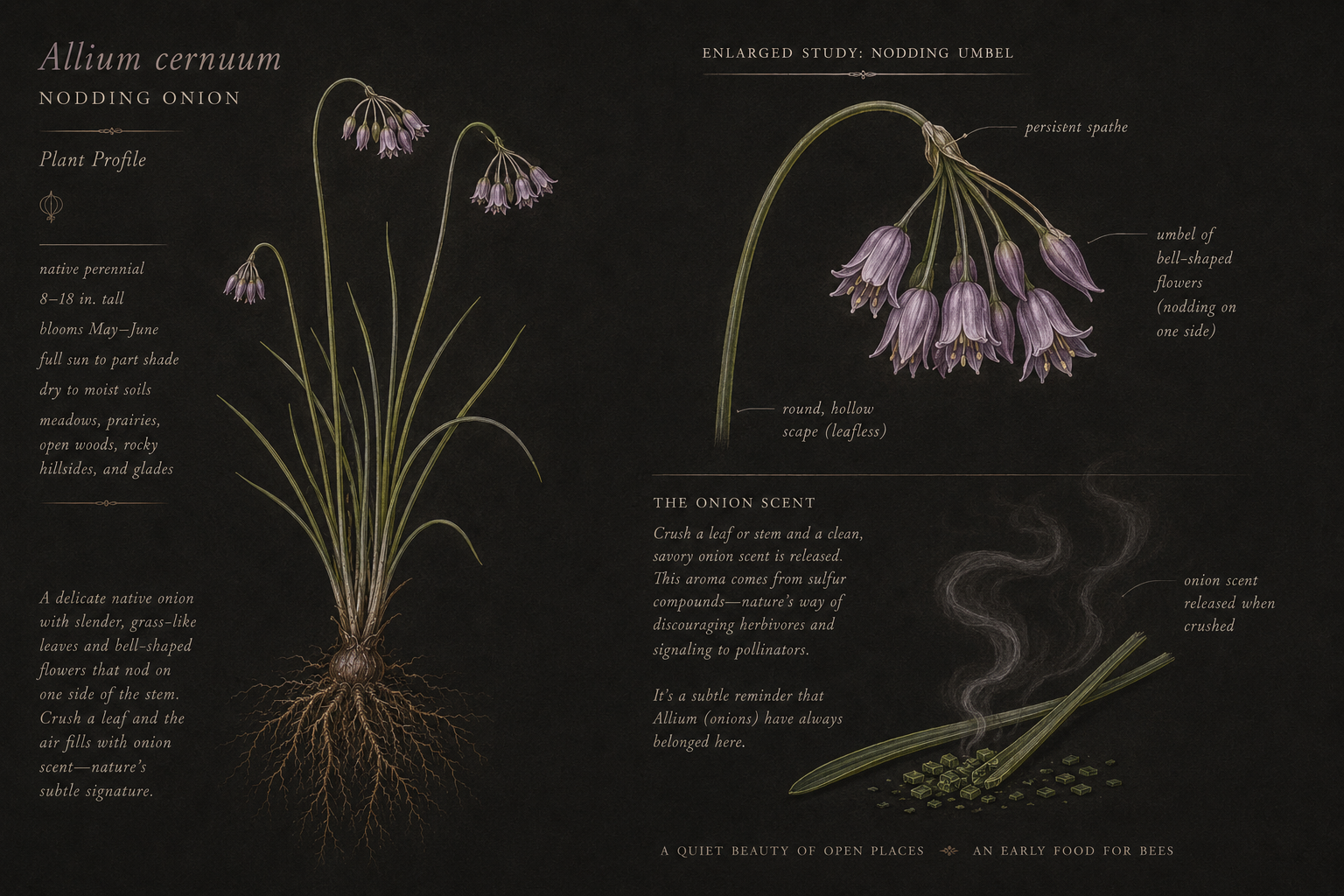
Nodding onion grows as a tidy clump of slender, grey-green leaves, flat to slightly channelled, rising from a cluster of small bulbs. In mid- to late summer a leafless flowering stalk lifts above the foliage and then bends sharply near the top, so the cluster of flowers hangs downward — the habit that gives the plant both its common name and its species name, cernuum, meaning "nodding" or "drooping." Each cluster is a loose umbel of many small bell-shaped flowers, typically pale pink to lilac, occasionally nearly white.

It is a plant of open, often lean ground — rocky slopes and ledges, dry prairie, gravelly banks, and the edges of open woods. The leaves and bulb carry the familiar onion-and-garlic scent of the genus Allium, released when the tissue is bruised or crushed. The clump tends to stay in place and increase slowly, by small bulb offsets and by seed, rather than running aggressively.

The whole plant carries the sulfur compounds characteristic of onions and garlic, released when leaves or bulbs are damaged. These compounds are thought to make the foliage unpalatable to deer and rabbits, so nodding onion often persists and flowers in places where heavier browsing pressure thins other summer-blooming forbs.

Best garden uses

Rock gardens Dry sunny borders Front-of-border edging Prairie & meadow plantings Among fine grasses Pollinator gardens

Botanical Plate

Nodding Onion

Botanical field-plate illustration of Nodding Onion
Allium cernuum · Botanical field plate

Seasonal Interest

A Year in the Life

Spring
Grassy grey-green leaves emerge from the bulb clumps and form low, fine-textured tufts. Foliage builds through late spring while the plant gathers reserves.
Early sum.
Leafless scapes rise above the leaves, each bending over near the tip so the developing flower cluster begins to nod. A papery sheath splits to release the buds.
Midsummer
Peak bloom — loose umbels of small pink-lilac bells hang from the bent stalks. Small bees and flies work the open clusters through July into August.
Late sum.
Flowering eases. As the seed capsules form and ripen, the stalk often straightens so the capsules turn upward — a reversal of the nodding habit.
Fall
Capsules split to release small black seeds; the foliage yellows and dies back. The bulb clump overwinters below ground, often a little larger than the year before.

Wildlife Support

Who Visits

The flowers are small and bell-shaped, held in an open cluster — a form that suits short-tongued insects able to reach nectar from the bell mouth or work the cluster from the side. Nodding onion is most active with smaller native bees and with flies, which match the flower size well.

🐝Native Beespollen & nectar
Sweat Bees (Halictidae) Small Carpenter Bees Leafcutter Bees Bumblebees Mining Bees
🪰Fliesnectar
Hover / Flower Flies (Syrphidae) Bee Flies Tachinid Flies
🦋Butterflies & Skippersnectar
Skippers Small butterflies

The same onion chemistry that flavours the foliage tends to keep deer and rabbits away from the leaves and bulbs. In gardens under browsing pressure, this can let nodding onion hold a flowering presence in mid- to late summer where unprotected forbs are repeatedly grazed.

Care & Cultivation

Growing Conditions

Nodding onion is undemanding in the open, well-drained conditions it favours. Lean, gritty, or rocky soils and full sun produce compact, upright clumps; richer or shadier sites tend to give looser, floppier growth and fewer flowers.

LightFull sun to part shade; fullest bloom and most upright form come in sun
SoilWell-drained; tolerates lean, gravelly, and rocky ground; average garden soil is fine if it drains
MoistureDry to medium; drought-tolerant once established; avoid consistently wet ground
HabitClump-forming from a cluster of bulbs; increases slowly by offsets and seed rather than running
DivisionLift and divide crowded clumps in spring or early fall every few years to keep them vigorous
Self-sowingSeeds modestly into open soil; deadhead to limit spread, or leave the capsules to ripen and drop
MaintenanceLow; cut back foliage as it yellows in late season. Generally left alone by deer and rabbits

Planting Partners

Grows Well With

The fine grey-green foliage and small lilac umbels read quietly against bolder prairie flowers and settle naturally among fine-textured grasses. Nodding onion suits the front and middle of a dry, sunny planting, where its modest scale is easy to see.

Fine-textured grasses

Little Bluestem Schizachyrium scoparium
Prairie Dropseed Sporobolus heterolepis
Pennsylvania Sedge Carex pensylvanica

Dry-prairie colour

Butterfly Weed Asclepias tuberosa
Purple Coneflower Echinacea purpurea
Blazing Star Liatris spp.

Lean-soil companions

Rattlesnake Master Eryngium yuccifolium
Mountain Mint Pycnanthemum spp.
Ohio Native Asters Symphyotrichum spp.

Did You Know?

The Stories Behind This Plant

01

The Bow, and the Recovery

The nodding habit is not fixed for the life of the plant. As the buds develop, the upper stalk bends sharply so the whole flower cluster hangs downward; the flowers open while facing the ground. Then, as the flowers fade and the seed capsules begin to swell and ripen, the stalk often straightens again and the capsules turn upward.

The reasons are not fully settled, but the downward nod is thought to shelter the nectar and pollen of the open bells from rain, while the later straightening lifts the ripening capsules to a height where wind and passing animals can shake the small seeds loose. The same stalk does two different jobs — presenting flowers, then dispersing seed — and changes its posture between them.

02

The Smell Is the Safest Field Mark

Several plants have narrow, grass-like leaves and small clustered flowers that can resemble a wild onion at a glance — including death camas (Toxicoscordion and relatives), which is toxic. The most reliable way to separate a true Allium from a look-alike is scent: the leaves and bulb of nodding onion and its relatives carry a distinct onion-and-garlic smell when crushed, while the toxic look-alikes do not. A plant with grass-like leaves and no onion scent should not be treated as a wild onion.

03

A Clump That Stays Put

Nodding onion grows from a cluster of small, slender bulbs that increase gradually over the years, adding offsets at the edges of the clump. It also sets seed, which can sprout in nearby open soil. Both forms of increase are slow and local rather than aggressive, so an established plant tends to widen into a fuller tuft in roughly the same spot — a quieter habit than the bulbil-forming wild onions that can colonise more freely.

04

An Onion in Name and in Chemistry

Nodding onion belongs to Allium, the same genus as the onions, garlic, leeks, and chives of the kitchen. Like its cultivated relatives, it produces sulfur-containing compounds that are released when the tissue is cut or chewed — the source of the smell and taste, and part of why browsing mammals tend to leave it alone. It has a long record of use as a wild food by Indigenous peoples and later settlers across its range, gathered for its mild edible bulbs and leaves.

Ohio Species

Ohio Wild Onions

Several native Allium grow in Ohio. All share the onion scent and a clumping, bulb-forming habit, but they differ in leaf, in how the flower cluster is held, and in the habitats where they are found — from open rocky ground to spring woodland.

Common · Spring–early summer

Wild Garlic / Meadow Garlic

Allium canadense

A widespread native of fields, meadows, and open woods. Its flower head often produces small bulbils — tiny aerial bulbs — alongside or instead of flowers, which can let it spread more freely. Blooms earlier than nodding onion, in late spring into early summer.

1–2 ftMediumSun–pt shadeBulbils

Woodland · Spring ephemeral

Ramps / Wild Leek

Allium tricoccum

A woodland species, unlike the open-ground onions. Broad, flat, glossy leaves appear in early spring and die back before the flower stalk blooms in summer. Found in rich, moist deciduous woods; long gathered as a wild food, and slow to recover where harvested heavily.

6–18 inMoist woodsShadeBroad leaf

Woodland · Narrow-leaved

Narrowleaf Wild Leek

Allium burdickii

A close relative of the ramp, sometimes treated as a variety of it, with noticeably narrower leaves and white flowers. Shares the rich-woodland habitat and spring-ephemeral foliage but tends to grow in drier upland sites and form smaller, tighter colonies.

6–14 inDry–moist woodsShadeNarrow leaf