Ohio Native Plant · Woodland Groundcover

Wild GingerAsarum canadense

Asarum canadense

A low, spreading carpet of paired, heart-shaped, softly hairy leaves that covers the shaded woodland floor — with a single curious maroon flower tucked at ground level beneath the foliage each spring. A slow, long-lived groundcover for shade.

✦ Hidden Spring Flowers
TypeNative groundcover
Height4–8 inches
BloomEarly to mid spring
LightPart to full shade
MoistureMedium to moist
FamilyAristolochiaceae

About This Plant

A Carpet for the Forest Floor

Wild ginger is a low, spreading groundcover of rich, shaded woods. It grows from a creeping rhizome that travels just beneath the leaf litter, sending up pairs of soft, heart-shaped leaves on hairy stalks. Over the years the rhizome branches and the plant knits into a dense, weed-suppressing mat only a few inches tall — a living carpet over the woodland floor rather than an upright specimen.

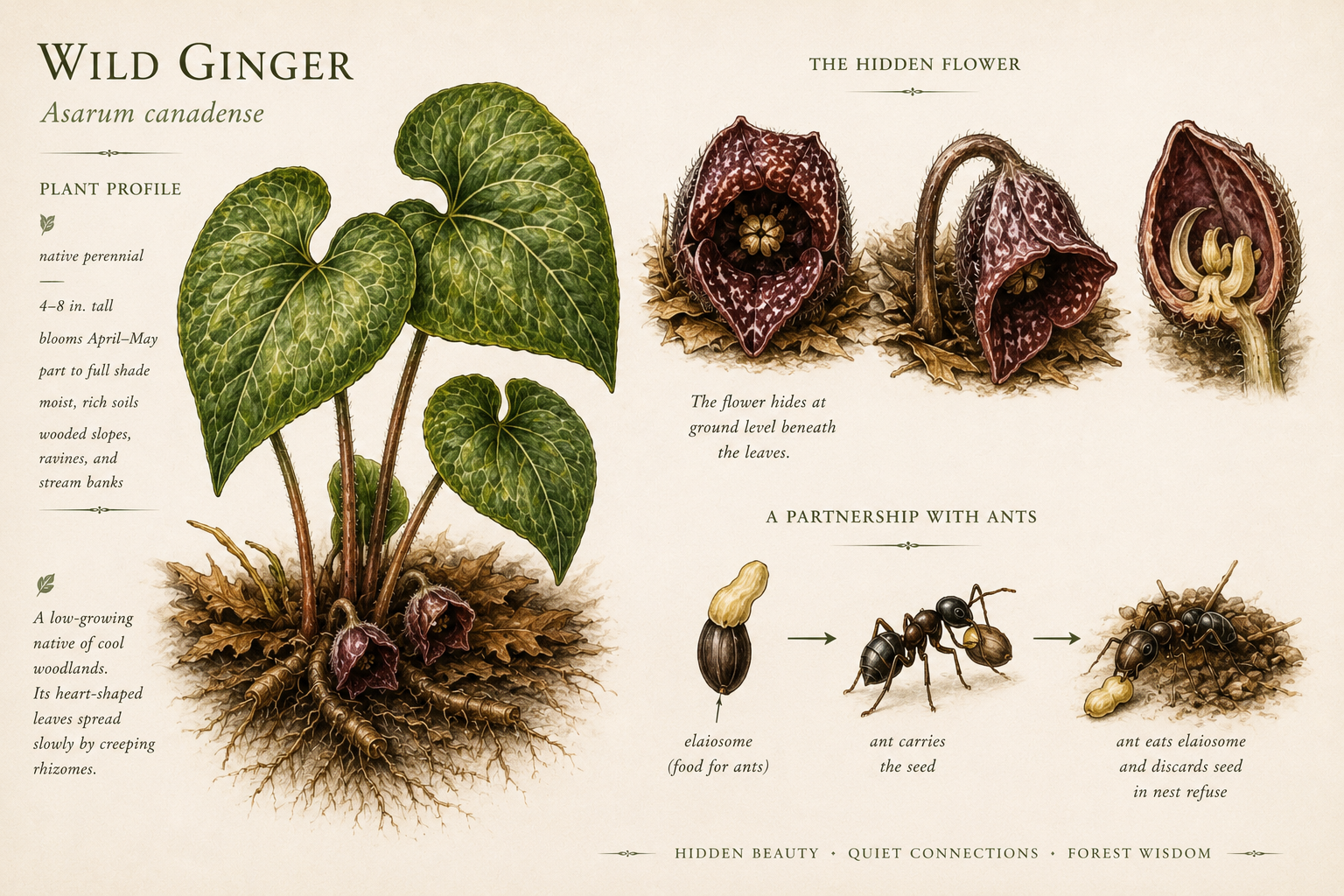
Its flower is one of the odd things about it. A single bloom is borne at ground level, in the fork between each pair of leaf stalks, often resting on the soil and hidden from above by the leaves. It is cup-shaped with three pointed, backward-curving lobes in a dull brownish-maroon, and has no true petals — the colour comes from the calyx. The broken rhizome carries a warm, spicy, ginger-like scent, which gives the plant its name, though it is not related to culinary ginger and belongs instead to the birthwort family.

As a groundcover, wild ginger works at soil level. Its overlapping leaves close into a low canopy that shades the ground, holds moisture, and suppresses weeds, while the colony shelters the small invertebrates and ground-foraging life of the woodland floor. It does slowly and for years what a layer of mulch does for a season — covering and protecting bare shaded soil.

Best garden uses

Shade groundcover Woodland gardens Under trees & shrubs Shaded slopes Along shaded paths Naturalizing in shade

Botanical Plate

Wild Ginger

Botanical field-plate illustration of Wild Ginger
Asarum canadense · Botanical field plate

Seasonal Interest

A Year in the Life

Spring
Paired leaves unfurl from the rhizome tips, and the single maroon flower opens at ground level in the fork between them — easy to miss unless you lift the leaves to look.
Late spr.
The leaves expand to full size and the colony closes into a low mat. The flowers fade and set seed near the soil.
Summer
A steady green groundcover through the season, holding the shaded ground. Ripe seeds, each with an oily appendage, are carried off by ants.
Fall
The foliage holds late into the season, then begins to decline as the canopy opens and the woods cool.
Winter
The leaves die back and the plant overwinters as a rhizome beneath the leaf litter — the colony returning each spring a little wider than before.

Wildlife Support

Who Visits

Because everything happens at ground level, wild ginger's wildlife relationships are unusual. Its dull, low-set flowers are visited by small early-season insects moving through the leaf litter, and it relies on ants — not birds or wind — to move its seeds. The flowers are also thought to set seed on their own when visitors are scarce.

🪰Early Flies & Gnatsflower visitors
Fungus Gnats Small Flies Early Midges
🪲Beetlesflower visitors
Ground-active Beetles
🐜Antsseed dispersal
Woodland Ants

The foliage contains compounds that make it bitter and generally unpalatable to deer and rabbits, so the carpet is rarely browsed. Its main wildlife value is structural — low, year-round cover over the soil, and a seed crop that feeds and is spread by ants.

Care & Cultivation

Growing Conditions

Wild ginger wants the conditions of the woodland floor it comes from: shade, rich soil, and steady moisture. Given those, it is durable and long-lived, though slow to establish — it can take a few seasons to begin spreading, after which it fills in steadily and asks for almost nothing.

LightPart to full shade; not suited to full sun, where the leaves scorch and fade
SoilRich, humusy woodland soil; moist but well-drained; slightly acidic to neutral
MoistureMedium to moist; keep from drying out, especially while establishing
HabitSpreads slowly by creeping rhizome to form a low mat; widens over years and is not aggressive
EstablishingSlow to start; top-dress with leaf litter or leaf-mould and water through the first seasons
DivisionLift and divide the rhizome in spring or early fall to expand the planting or share it
MaintenanceVery low; leave fallen leaves in place as mulch. Generally untouched by deer and rabbits

Planting Partners

Grows Well With

Wild ginger fills the lowest layer of a shaded planting, knitting between taller woodland plants and beneath shrubs and trees. It pairs naturally with other shade-tolerant natives that share its preference for rich, cool ground.

Woodland groundlayer

Pennsylvania Sedge Carex pensylvanica
Cardinal Flower Lobelia cardinalis
Foxglove Beardtongue Penstemon digitalis

Shade-tolerant colour

Ohio Native Asters Symphyotrichum spp.
Goldenrod Solidago spp.
Golden Alexanders Zizia aurea

Overhead structure (the shade it needs)

Serviceberry Amelanchier spp.

Did You Know?

The Stories Behind This Plant

01

The Flower That Hides on the Ground

Most flowers advertise themselves; wild ginger's seems built to hide. A single bloom sits at ground level in the crotch between the two leaf stalks, often lying against the soil and screened from above by the leaves — you have to part the foliage to find it. It is a cup of three pointed, recurved lobes in a dull purple-brown, with no true petals.

That colour and ground-level position gave rise to a long-held idea: that the flower mimics decaying matter to attract early flies and gnats emerging from the leaf litter in spring. It is a memorable story, but the evidence is mixed — studies suggest insect visits are often few, and that wild ginger frequently pollinates itself. The flower may be less a trap than a quiet backup plan.

02

Planted by Ants

Each seed carries a small, oil-rich appendage called an elaiosome. Ants find it worth collecting and carry the seeds back to their nests, eat the appendage, and discard the seed, unharmed, in their refuse — leaving it planted in loose, enriched soil a short distance from the parent. This partnership, called myrmecochory, is how a slow, low groundcover reaches beyond the patient creep of its rhizome to start new patches nearby.

03

Ginger in Name Only

The spicy scent of the broken rhizome earned wild ginger its name, and historically the root was used, dried, as a seasoning and in folk medicine. But the plant is not related to culinary ginger at all — that is Zingiber, from a different family entirely. Wild ginger belongs to the birthwort family, and it contains aristolochic acid, a compound now known to be toxic to the kidneys and carcinogenic. Its culinary past is a matter of history; it is not considered safe to eat today.

04

A Groundcover in Slow Motion

Wild ginger spreads by a rhizome that creeps along just under the leaf litter, rooting as it goes and lifting a fresh pair of leaves every so often. The pace is unhurried — a new planting can take two or three years to look like much — but the result is a durable, long-lived carpet that holds its ground and widens a little each season. Patience is the price of a groundcover that, once settled, largely takes care of itself.

Shade Groundcovers

Ohio's Woodland Carpet

Wild ginger is one of several native plants that spread into low carpets across the shaded woodland floor. They share the groundcover habit — covering bare, shaded soil — but differ in leaf, in flower, and in the exact conditions they prefer.

Frothy spring bloom

Foamflower

Tiarella cordifolia

A clumping woodland groundcover with lobed, heart-shaped leaves and airy spikes of frothy white flowers in spring. It spreads by short runners to form colonies in rich, moist shade, and unlike wild ginger it carries its flowers well above the foliage.

6–12 inMoistPart–full shadeWhite spikes

Low & succulent

Wild Stonecrop

Sedum ternatum

A low, creeping native sedum with fleshy, rounded leaves in whorls and white star-shaped flowers in spring. It carpets shaded, rocky ground and ledges, tolerating thinner, drier soils than wild ginger while keeping the same low, spreading habit.

3–6 inDry–medPart shadeSucculent

Grassy groundcover

Pennsylvania Sedge

Carex pensylvanica

A fine-textured native sedge that spreads by rhizome into a soft, grassy groundcover, often used as a lawn alternative for shade. It knits well between taller woodland plants and, like wild ginger, forms a continuous low layer rather than distinct clumps.

6–8 inDry–medPart–full shadeSpreading