Ohio Native Plant · Spring Wildflower

Wild GeraniumGeranium maculatum

Geranium maculatum

Clumps of deeply lobed leaves and loose clusters of upward-facing rose-pink flowers in spring, followed by the long beaked "cranesbill" seedpods that fling their seeds when ripe. A woodland wildflower for part shade.

✦ Catapulting Seeds
TypeNative perennial
Height1.5–2 feet
BloomSpring to early summer
LightPart shade to full sun
MoistureMedium
FamilyGeraniaceae

About This Plant

Five Pink Petals and a Crane's Bill

Wild geranium forms a tidy clump of long-stalked leaves, each deeply cut into five to seven toothed lobes that spread like an open hand. Above the foliage, loose clusters of flowers open in spring — upward-facing saucers of five rose-pink to lavender-pink petals, an inch or more across, marked with faint darker lines running toward the centre. White-flowered plants turn up now and then. It is one of the steadier, showier blooms of the spring woods.

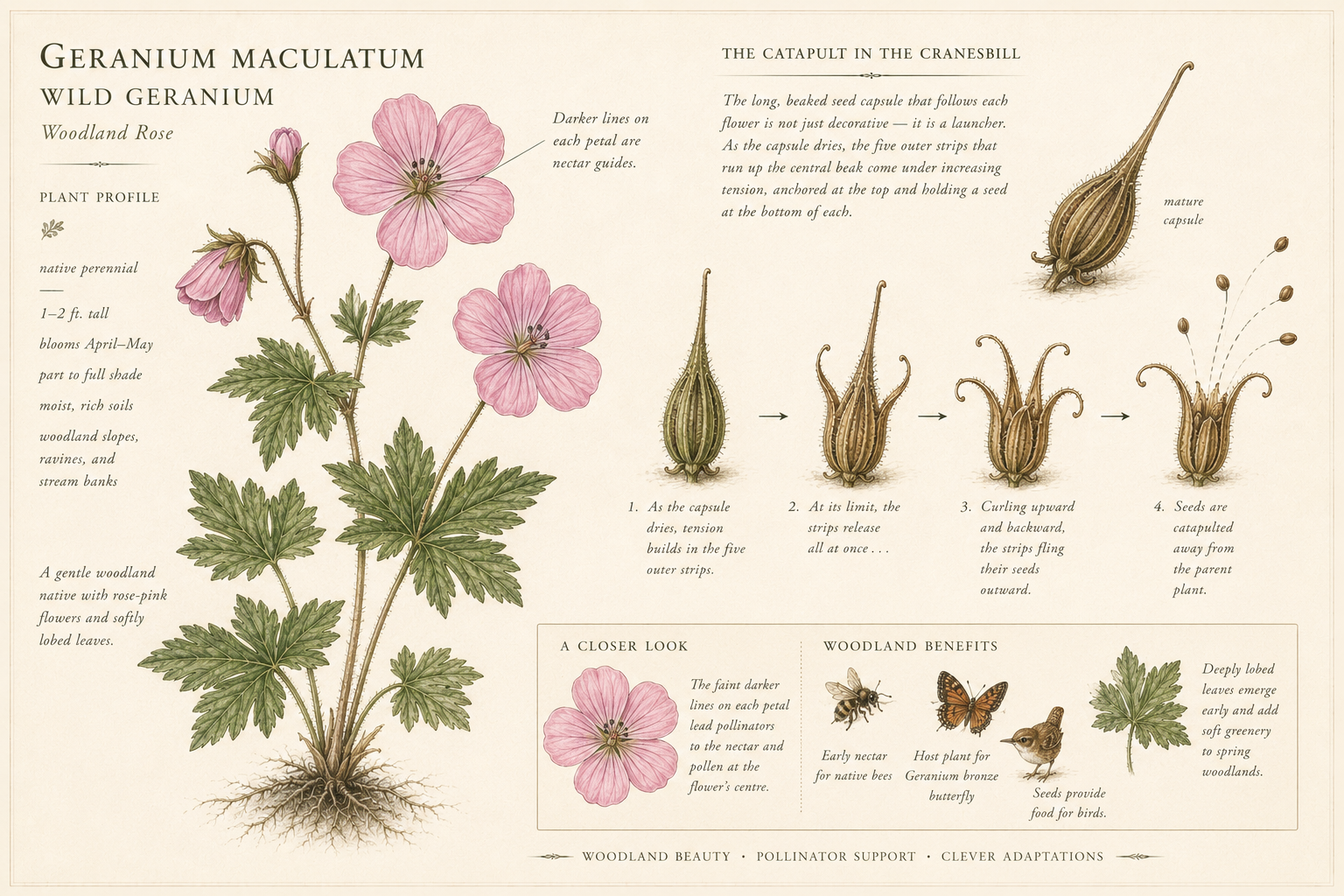
The fruit is what gives the whole genus its name. After each flower fades, it forms a long, slender, beak-like capsule — the "cranesbill," from the Greek for crane, geranos. As the capsule ripens and dries, it builds tension, and then springs open: the five segments curl sharply back along the central beak and flick the seeds away. Wild geranium grows in open woods, woodland edges, shaded slopes, and meadows, in part shade to sun and average, medium-moisture soil, slowly spreading into loose colonies.

The open, upward-facing flowers hold their nectar and pollen where a wide range of visitors can reach them, and the faint dark lines on the petals — nectar guides — steer bees to the centre. Blooming in spring, when many native bees are just emerging, wild geranium is a broadly useful early source of food rather than a specialist's flower.

Best garden uses

Woodland gardens Part-shade borders Woodland edges Pollinator gardens Naturalizing in shade Massed drifts

Botanical Plate

Wild Geranium

Botanical field-plate illustration of Wild Geranium
Geranium maculatum · Botanical field plate

Seasonal Interest

A Year in the Life

Early spr.
The lobed foliage emerges in a fresh green mound and the flowering stems rise, building toward bloom as the woods leaf out.
Spring
Peak bloom — loose clusters of rose-pink flowers open above the leaves, an early source of nectar and pollen for emerging native bees.
Early sum.
Flowering finishes and the beaked cranesbill capsules ripen, dry, and spring open — flinging seeds out from the parent plant.
Summer
The foliage carries on as a green mound; in dry shade it may tire or partly go dormant. Cutting it back brings a fresh flush.
Fall–Winter
Leaves sometimes colour reddish before dying back. The rhizome and self-sown seedlings overwinter, returning and widening the colony.

Wildlife Support

Who Visits

Wild geranium's open spring flowers are worked mostly by bees, which take both nectar and pollen, with flies and the occasional butterfly joining in. Because it blooms early and is widely accessible, it supports a broad mix of visitors rather than a single specialist.

🐝Native Beesnectar & pollen
Mining Bees Bumblebees Mason Bees Sweat Bees Small Carpenter Bees
🪰Fliesnectar & pollen
Hover / Flower Flies Bee Flies
🦋Butterfliesnectar
Spring butterflies Skippers

Among its bee visitors are some that specialise on geraniums, gathering pollen mainly from this and related plants — a reminder that even a generalist-looking flower can be especially important to a few species. Wild geranium is also generally among the plants deer tend to pass over, though browsing varies from place to place.

Care & Cultivation

Growing Conditions

Wild geranium is an easy, long-lived plant in the dappled light and average soil of a woodland edge. It is happiest with some shade and steady moisture; in hot, dry sun the foliage may scorch or go partly dormant by midsummer, recovering when conditions ease.

LightPart shade to full sun; light shade is ideal, especially in hot sites
SoilAverage to rich, humusy, and well-drained; tolerant of most garden soils
MoistureMedium; may go partly summer-dormant if dry; avoid constantly wet ground
HabitClump-forming; spreads slowly by rhizome and self-seeding into loose drifts; not aggressive
Self-sowingCatapulted seeds sprout nearby; leave to naturalise, or deadhead to limit spread
After bloomFoliage may tire by midsummer; cut back hard to bring up fresh leaves
MaintenanceLow; divide in spring or fall if needed. Generally passed over by deer

Planting Partners

Grows Well With

Wild geranium fills the middle layer of a part-shade planting, its mounded foliage and spring flowers knitting between a low groundcover beneath and taller plants behind. It pairs naturally with the other woodland-edge natives that share its light and soil.

Woodland floor

Wild Ginger Asarum canadense
Wild Columbine Aquilegia canadensis
Pennsylvania Sedge Carex pensylvanica

Part-shade colour

Foxglove Beardtongue Penstemon digitalis
Golden Alexanders Zizia aurea
Cardinal Flower Lobelia cardinalis

Later succession

Ohio Native Asters Symphyotrichum spp.
Goldenrod Solidago spp.
Wild Bergamot Monarda fistulosa

Did You Know?

The Stories Behind This Plant

01

The Catapult in the Cranesbill

The long, beaked seed capsule that follows each flower is not just decorative — it is a launcher. As the capsule dries, the five outer strips that run up the central beak come under increasing tension, anchored at the top and holding a seed at the bottom of each.

When the tension reaches its limit, the strips release all at once, curling sharply upward and backward and flinging their seeds outward, sometimes several feet from the plant. It is a spring-loaded form of seed dispersal — the plant doing its own sowing, throwing the next generation clear of the parent in a single motion.

02

Lines That Point the Way

The faint darker lines running across each petal toward the centre are nectar guides — visual cues that steer a visiting bee to the reward and, in doing so, line it up against the flower's pollen and stigma. Wild geranium adds a second trick of timing: a flower often opens in a male phase, shedding pollen first, and only later becomes female, with its stigma receptive. By separating the two phases, the flower nudges bees to carry pollen from one plant to another rather than pollinating itself.

03

Spotted, Cranesbill, Alumroot

The species name maculatum means "spotted," for the pale blotches that older leaves can develop. "Cranesbill" comes from the beaked fruit, and the plant has also long been called alumroot or simply cranesbill, its tannin-rich root once used as an astringent in folk medicine. That use is a matter of history rather than a recommendation — the modern value of the plant is in the garden and for wildlife, not the medicine chest.

04

A Quiet Colonizer

Wild geranium spreads two ways at once: outward by a slowly branching underground rhizome, and outward again by its catapulted seed. Neither is aggressive, so over the years a single plant becomes a loose, drifting colony that fills part-shade ground without crowding out its neighbours — a patient, well-mannered way of covering ground that asks very little once it has settled in.

Telling Them Apart

True Cranesbills, and the Garden "Geranium"

Ohio has a few true native geraniums — the cranesbills — of which wild geranium is the largest and showiest. Confusingly, the "geraniums" sold for pots and window boxes are not true geraniums at all, which is worth knowing when choosing plants for a native garden.

Native · Small & weedy

Carolina Cranesbill

Geranium carolinianum

A small native cranesbill of open, disturbed ground, with deeply cut leaves and tiny pale pink flowers clustered tight at the stem tips. Easy to overlook and rather weedy, it shares the beaked seed capsule but is a fraction of wild geranium's size and show.

6–24 inPale pinkSun · open groundNative

Not a true geranium

Garden "Geranium"

Pelargonium spp.

The familiar red-and-pink "geraniums" of pots and window boxes are not Geranium at all — they are Pelargonium, a separate genus from southern Africa. Tender and non-native, they share a family and an old common name with the cranesbills, but little else.

TenderBedding plantNon-nativeDifferent genus