Ohio Native Plant · Spring Wildflower

Wild ColumbineAquilegia canadensis

Aquilegia canadensis

Airy mounds of delicate blue-green foliage and nodding red-and-yellow flowers — each with five upward-pointing nectar spurs and a tuft of dangling gold stamens — in spring. A wildflower of rocky woods and ledges, and a favourite of hummingbirds.

✦ Hummingbird Flower
TypeNative perennial
Height1–2 feet
BloomSpring to early summer
LightPart shade to full sun
MoistureDry to medium
FamilyRanunculaceae

About This Plant

A Flower Built for Hovering

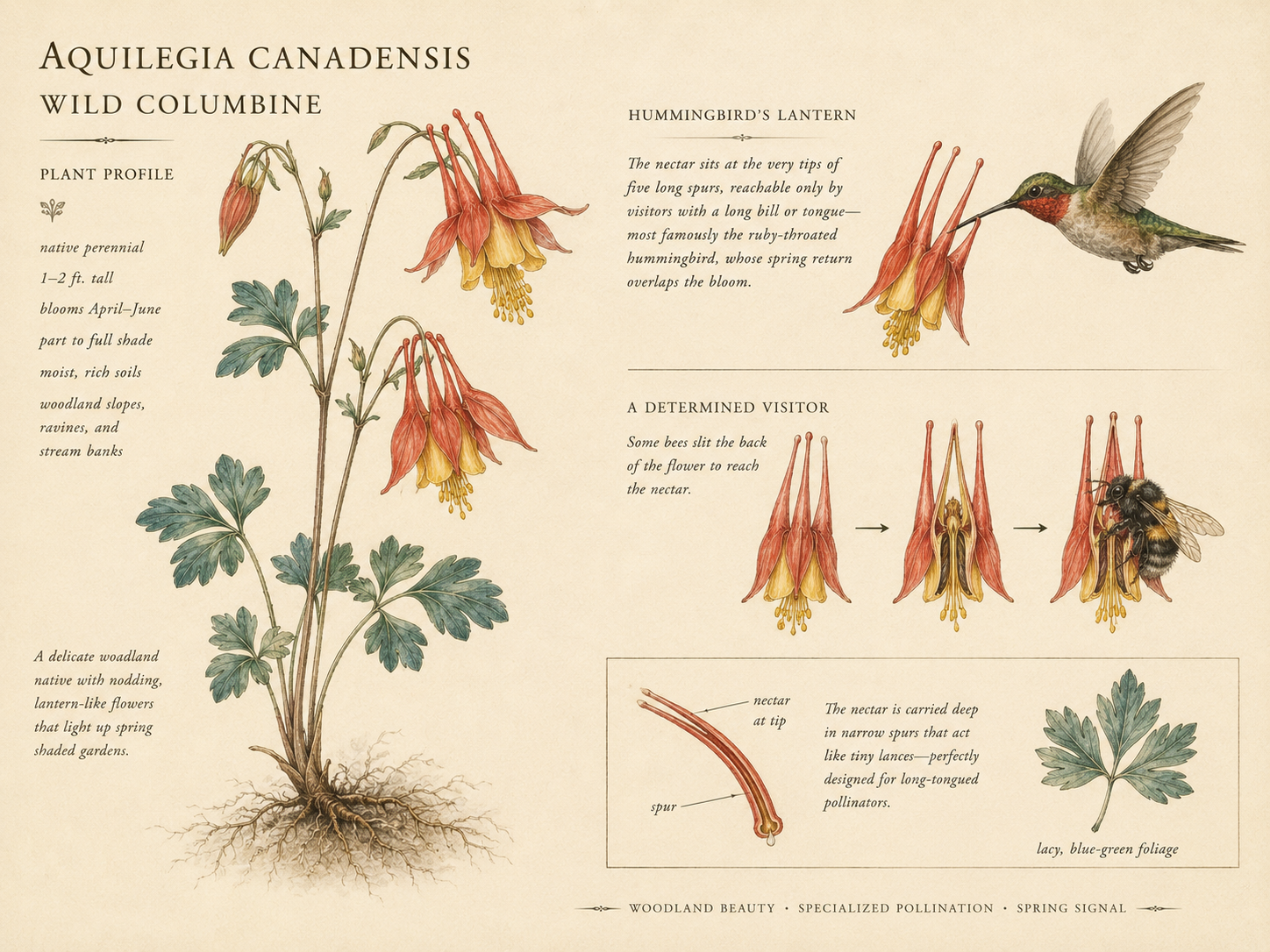
Wild columbine carries one of the most distinctive flowers of the spring woods. Each bloom nods downward on a slender stem: five red sepals spread behind five petals, and each petal is drawn back into a long, upward-pointing tube — a spur — tipped with a knob that holds nectar. Below the downward-facing mouth hangs a small brush of yellow stamens. The whole flower reads as a little red-and-gold lantern, swinging from a wiry stalk.

Beneath the flowers sits a soft mound of airy, blue-green foliage, divided again and again into small, rounded, lobed leaflets. Wild columbine grows on rocky wooded slopes, ledges, cliffs, and clearings, in part shade to sun and in well-drained — even thin and rocky — soil. Individual plants are fairly short-lived, but the species persists by sowing itself freely, drifting through a site from year to year.

The nectar sits at the very tips of five long spurs, reachable only by visitors with a long bill or tongue — most famously the ruby-throated hummingbird, whose spring return overlaps the bloom. The red colour, the nodding posture, and the spurred shape together make wild columbine a textbook example of a flower built around the animals that feed at it.

Best garden uses

Rock gardens Woodland edges Part-shade borders Dry shade Hummingbird gardens Naturalizing

Botanical Plate

Wild Columbine

Botanical field-plate illustration of Wild Columbine
Aquilegia canadensis · Botanical field plate

Seasonal Interest

A Year in the Life

Early spr.
The lacy blue-green foliage emerges in a low mound and the flowering stems rise, just as the first hummingbirds return north.
Spring
Peak bloom — nodding red-and-yellow flowers swing above the foliage, worked by hummingbirds and long-tongued insects through spring into early summer.
Early sum.
Flowering finishes. The nodding flowers give way to upright seed follicles that dry and split, scattering small, shiny black seeds.
Summer
Foliage carries on, though it may be traced with the harmless pale trails of the columbine leafminer. Cutting it back brings a fresh flush.
Fall–Winter
The plant dies back, while self-sown seedlings and the crown overwinter — new plants appearing nearby the following spring.

Wildlife Support

Who Visits

Wild columbine's spurred, nectar-rich flowers reward visitors that can reach deep — and, because they bloom early, they arrive when little else does. Hummingbirds are the signature visitor, joined by long-tongued bees and moths, while the foliage feeds a few specialist insects.

🐦Hummingbirdsnectar
Ruby-throated Hummingbird
🐝Long-tongued Bees & Mothsnectar
Bumblebees Mason Bees Hawk / Sphinx Moths
🦋Butterfliesnectar & host
Columbine Duskywing Spring butterflies

Not every visitor plays fair: short-tongued bumblebees sometimes "rob" the nectar by biting through the spur tips, taking the reward without pollinating. The foliage is also the larval food of the columbine duskywing, a small butterfly, and wild columbine is generally not a favourite of deer.

Care & Cultivation

Growing Conditions

Wild columbine is easygoing in the lean, well-drained conditions it favours, and is happiest in light shade. It resents wet, heavy ground. Because individual plants are short-lived, the trick is to let it self-sow — a planting renews and drifts on its own seedlings rather than persisting as the same clumps.

LightPart shade to full sun; light shade is ideal, especially in hot, dry sites
SoilAverage to lean and well-drained; tolerates rocky, thin, and dry soils; dislikes wet or heavy ground
MoistureDry to medium; drought-tolerant once established
HabitShort-lived perennial that self-sows reliably; the planting persists through seedlings as older plants fade
Self-sowingSows freely into crevices and bare ground; leave seed heads to naturalise, or deadhead to limit it
LeafminerPale, winding leaf trails are cosmetic and harmless; cut foliage back after bloom for a fresh flush
MaintenanceLow; little needed beyond optional deadheading or cutting back

Planting Partners

Grows Well With

Wild columbine suits the dappled light and lean soil of a woodland edge or rocky slope, where its airy foliage and dangling flowers read well against bolder leaves and later bloom. Its early flowering pairs naturally with spring and early-summer companions.

Woodland edge

Wild Ginger Asarum canadense
Pennsylvania Sedge Carex pensylvanica
Foxglove Beardtongue Penstemon digitalis

Rocky & lean soil

Little Bluestem Schizachyrium scoparium
Prairie Dropseed Sporobolus heterolepis
Butterfly Weed Asclepias tuberosa

Spring into summer

Golden Alexanders Zizia aurea
Wild Bergamot Monarda fistulosa
Purple Coneflower Echinacea purpurea

Did You Know?

The Stories Behind This Plant

01

A Flower Shaped Around the Hummingbird

Almost everything about the flower points to bird pollination. It is red — a colour birds notice and many insects largely overlook. It nods downward, suiting a visitor that hovers rather than lands. And its nectar is held at the tips of five long spurs, out of reach of most short-tongued insects. The ruby-throated hummingbird, returning north as columbine blooms, can hover beneath a flower and reach the spurs with its long bill and tongue, pollinating as it feeds.

It is not the only visitor that can manage the spurs — long-tongued bees and hawk moths reach the nectar too. And some take a shortcut: short-tongued bumblebees occasionally bite a hole near the spur tip and drink directly, "robbing" the flower of nectar without pollinating it.

02

Eagles and Doves

The plant carries two birds in its names. The genus, Aquilegia, is usually traced to the Latin aquila, eagle — the curved, clawed spurs likened to an eagle's talons. The common name, columbine, comes from columba, dove: turned upside down, the ring of five spurred petals was seen as a cluster of five doves gathered head to head. One flower, read two different ways.

03

Built to Move On

A single columbine plant rarely lives long, but the species is a confident wanderer. Once the nodding flowers fade, the seed follicles turn upright and split, spilling small, glossy black seeds that sprout in crevices and bare patches nearby. Rather than holding one spot for decades, a columbine planting drifts — fading here, appearing there — so it is best thought of as a population that renews itself rather than a permanent clump.

04

The Leafminer's Trails

The pale, winding lines that often appear on columbine leaves are the work of the columbine leafminer, a small fly whose larvae tunnel in the thin layer between the leaf surfaces, leaving a meandering trail behind them. The mines look dramatic but are cosmetic — they rarely harm the plant. Where they bother the eye, shearing the foliage back after flowering brings up a clean new flush of leaves.

Telling Them Apart

Native or Garden Columbine?

Wild columbine is the only columbine native to Ohio. Most columbines seen in gardens are European or hybrid, and because columbines cross with one another freely, it helps to know which is which — especially near a native planting you'd like to keep true.

Non-native · Garden escape

European Columbine

Aquilegia vulgaris

The old cottage-garden columbine, in blue, purple, or white, with stouter flowers and short, hooked (rather than straight) spurs. Introduced from Europe, it escapes gardens and naturalises, and is sometimes found in the wild — but it is not native to Ohio.

1–3 ftBlue–purpleShort hooked spursNon-native

Non-native · Cultivated

Garden Hybrid Columbines

Aquilegia × hybrids

The large, often upward-facing columbines of the nursery trade, bred in many colours and forms. They are not native and can cross-pollinate wild columbine, so where keeping the native true matters, it is worth siting hybrids well away from it — or leaving them out.

VariesMany coloursShowyNon-native