Ohio Native Plant · Summer Wildflower

Ohio SpiderwortTradescantia ohiensis

Tradescantia ohiensis

A clump of long, arching, blue-green leaves and clusters of three-petaled violet-blue flowers — each one open for a single morning — appearing a few at a time from late spring through summer. A tough, adaptable wildflower of prairies, meadows, and roadsides.

✦ One-Day Flowers
TypeNative perennial
Height2–3 feet
BloomLate spring to summer
LightFull sun to part shade
MoistureDry to medium
FamilyCommelinaceae

About This Plant

Three Petals, One Morning

Ohio spiderwort grows as an upright clump of long, narrow leaves that arch outward and fold lengthwise into a shallow channel, clasping the stem where they meet it. The foliage carries a waxy blue-green, slightly powdery cast — the "smooth" or glaucous quality that separates this species from its hairier relatives. The stems are topped by clusters of buds and flowers held above a pair of spreading, leaf-like bracts.

Each flower has three rounded petals, usually a clear blue to violet-purple — occasionally rose or white — set off by six bright yellow stamens whose slender filaments are fringed with fine hairs. A flower opens in the morning and closes by afternoon, often sooner in heat, lasting only a single day; but the cluster opens just a few flowers at a time, so a plant can keep blooming for weeks. Ohio spiderwort is notably adaptable, growing in prairies, meadows, open woods, thickets, and along roadsides and railway banks, in dry to medium soils and full sun to part shade.

Spiderwort flowers offer pollen rather than nectar, and they open early and close by midday. Together this concentrates their value into the morning hours, when pollen-collecting bees — bumblebees especially — work the fresh flowers. The plant's role in the garden is largely as an early-day pollen source through late spring and summer, before the day's flowers have closed.

Best garden uses

Prairie & meadow Sunny borders Naturalized areas Pollinator gardens Tough & poor-soil sites Cottage-style plantings

Botanical Plate

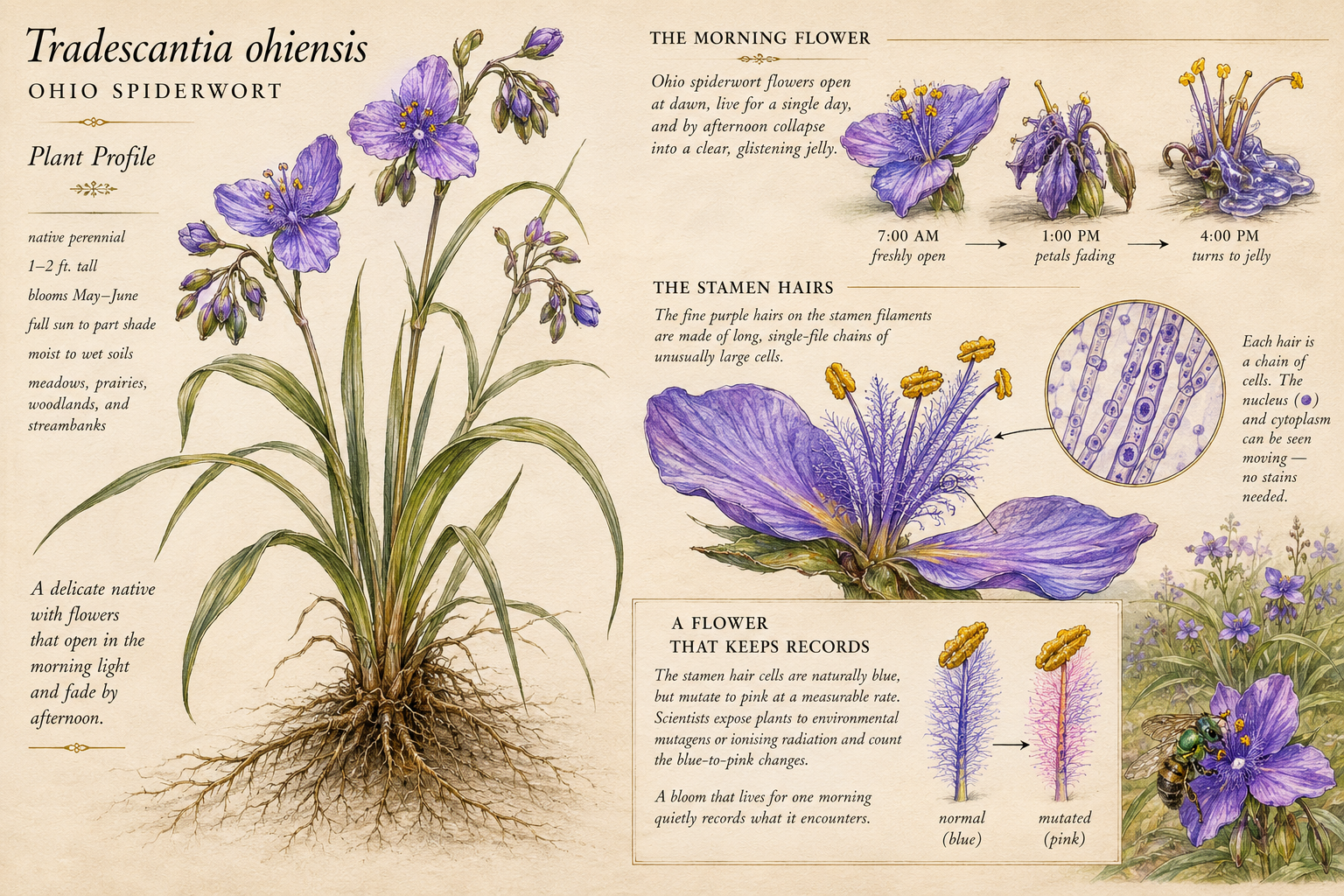
Ohio Spiderwort

Botanical field-plate illustration of Ohio Spiderwort
Tradescantia ohiensis · Botanical field plate

Seasonal Interest

A Year in the Life

Spring
Clumps of arching grass-like foliage emerge and the stems rise. The first flower clusters form at the stem tips, gathering buds above their bracts.
Late spr.
Bloom begins — the first violet-blue flowers open in the morning and close by afternoon, with new buds waiting behind them.
Summer
Peak bloom — a few fresh flowers open each morning over many weeks, worked by bees in the early hours before the day's flowers close.
Midsummer
Flowering slows and the foliage may flop or look tired after heavy bloom. Cutting the clump back hard often brings a flush of fresh leaves, and sometimes a second, lighter bloom.
Fall
Small seed capsules ripen and the foliage dies back. The plant overwinters as a clump of roots, returning the following spring.

Wildlife Support

Who Visits

Because the flowers provide pollen but little or no nectar, and close by midday, their visitors are mostly pollen-collecting bees active in the morning. Long-tongued and short-tongued bees both work the flowers, and hover flies visit for pollen as well.

🐝Native Beespollen
Bumblebees Long-horned Bees Sweat Bees Mining Bees Leafcutter Bees
🪰Fliespollen
Hover / Flower Flies Bee Flies

Because the flowers close in the afternoon, Ohio spiderwort is most useful to pollinators in the morning, which makes it a good companion to later-opening, nectar-rich flowers that carry visitors through the rest of the day. The leafy clumps also offer low cover for ground-active insects.

Care & Cultivation

Growing Conditions

Ohio spiderwort is undemanding and tolerant of poor, dry ground — qualities that make it easy to grow and, in richer conditions, sometimes a little too enthusiastic. An open, sunny site keeps it compact and full of flower; rich, moist soil tends to produce lax, floppy growth and more self-sowing.

LightFull sun to part shade; fullest bloom in sun, while light afternoon shade can keep foliage fresher in heat
SoilAdaptable; tolerates poor, dry, and clay soils; rich soil encourages floppy growth
MoistureDry to medium; drought-tolerant once established
After bloomFoliage often flops or yellows after the main bloom; cutting the clump back hard renews the leaves and can prompt a second flush
SpreadingSelf-sows readily and can spread, especially in rich, moist ground; deadhead to keep it in bounds
DivisionLift and divide clumps in spring or fall to manage size or make more plants
MaintenanceLow; mainly cutting back and deadheading to refresh foliage and limit seeding

Planting Partners

Grows Well With

The strappy, arching foliage and clear blue flowers sit well among fine prairie grasses and warm-coloured summer flowers, where the early-day blooms add cool colour before the heat of the day. Its toughness suits dry, sunny plantings and naturalised areas.

Prairie grasses

Little Bluestem Schizachyrium scoparium
Prairie Dropseed Sporobolus heterolepis
Pennsylvania Sedge Carex pensylvanica

Sun-loving colour

Butterfly Weed Asclepias tuberosa
Purple Coneflower Echinacea purpurea
Black-eyed Susan Rudbeckia hirta

Early-to-mid season

Golden Alexanders Zizia aurea
Wild Bergamot Monarda fistulosa
Coreopsis Coreopsis spp.

Did You Know?

The Stories Behind This Plant

01

A Flower That Lasts a Morning

Each spiderwort flower is open for only a single day. It unfolds in the morning and, particularly in sun and heat, closes again by early afternoon. Because the cluster carries many buds and opens just a few at a time, the plant flowers steadily for weeks even though no individual bloom lasts beyond a day.

The spent flowers behave unusually as they fade. Rather than drying and dropping as papery petals, they collapse into a soft, translucent, jelly-like fluid — the petals deliquesce, a trait shared across the spiderworts. What looks like a small bead of clear gel at the tip of a stem is yesterday's flower.

02

Hairs You Can Watch Living

The fine hairs fringing the stamen filaments are made of long, single-file chains of unusually large cells. Because the cells are big and the hairs nearly transparent, a single stamen hair laid under a microscope is a classic way to watch a living plant cell at work — the nucleus, and the slow circulation of the cytoplasm around it, are visible without stains. Generations of biology students have met the living cell through a spiderwort stamen.

03

The Spiderwort Radiation Test

Those same stamen hairs gave Tradescantia a second scientific life. In certain spiderworts the hair cells are normally blue, but mutate to pink at a measurable rate. Researchers have used the frequency of these blue-to-pink changes as a living test for mutagens and ionising radiation in the environment, exposing plants to a site and counting the colour shifts. The flower built for a single morning turns out to keep a quiet record of its surroundings.

04

Tradescant, and the "Spider" in Spiderwort

The genus Tradescantia honours John Tradescant, the elder and the younger, gardeners and plant collectors in seventeenth-century England. The common name "spiderwort" is less settled: it has been linked to the angular, leggy arrangement of the leaves, to the fine threads that string out from a cut stem like a spider's silk, and to the hairy stamens — with "wort" simply an old word for a useful plant. Ohio spiderwort also goes by the name bluejacket.

Ohio Species

Ohio Spiderworts

Ohio spiderwort is the most familiar of several Tradescantia that grow in the state. They are close enough to overlap and hybridise where they meet, and are told apart by details of leaf, stem, and the hairs on the sepals — with habitat offering a first clue.

Woods & edges · Hairy

Virginia Spiderwort

Tradescantia virginiana

A spiderwort of woodland edges and clearings, generally greener and hairier than Ohio spiderwort, without the waxy bloom, and with sepals evenly covered in glandular hairs. Often shorter and earlier, it overlaps with Ohio spiderwort and the two can intergrade where they meet.

1–2 ftMediumPt shadeHairy sepals

Woodland · Part shade

Zigzag Spiderwort

Tradescantia subaspera

The shade-dwelling member of the group — a plant of moist woods, ravines, and shaded stream banks rather than open prairie. It is told by its broader leaves and a stem that bends in a distinct zigzag between them, and it often carries some of its blue flowers in the leaf axils along the stem, not only at the tip. Blooms later, into late summer.

1–3 ftMoistPart–full shadeZigzag stem